


Being underwater on your mortgage — owing more than your home’s current market value — is more common than most borrowers realize, and it does not automatically disqualify you from refinancing. Federal programs, VA entitlements, and wholesale broker access have created real pathways for borrowers with negative equity to lower their rate, reduce their monthly payment, or restructure their debt entirely.
Here is a concrete example of what that looks like in practice. A borrower with a $320,000 FHA loan balance on a home now worth $295,000 is underwater by $25,000, sitting at 108% LTV. At their current rate of 7.25%, their principal and interest payment is approximately $2,183 per month. Through FHA Streamline refinance — which requires no appraisal and makes the home’s current value completely irrelevant — that same borrower could refinance to 6.375%, dropping their payment to approximately $1,997 per month. That is roughly $186 in monthly savings. With closing costs around $3,500, the break-even point lands at approximately 19 months. The MIP (mortgage insurance premium) carries over on an FHA Streamline, so the savings calculation is on the base rate only — but the math still works for most borrowers planning to stay put.
This guide covers eight legitimate underwater mortgage refinance solutions available in 2026, evaluated on program eligibility, LTV ceiling, credit requirements, and real-world applicability for borrowers in Virginia, Florida, Tennessee, and Georgia. Whether you are a veteran with an existing VA loan, an FHA borrower who purchased at peak pricing, or a conventional homeowner watching equity erode, at least one of these solutions likely applies to your situation.
Duane Buziak, NMLS #1110647 | Coast2Coast Mortgage LLC, NMLS #376205
1. MortgageRefinanceRates.com (Coast2Coast Mortgage LLC)
Best for: Underwater borrowers who need program flexibility across VA, FHA, HIRO, FMERR, and USDA simultaneously.
MortgageRefinanceRates.com is a wholesale mortgage broker platform operated by Coast2Coast Mortgage LLC, offering NoTouch Credit Pull pre-approval and access to over 500 wholesale lenders across multiple underwater refinance programs.
Where This Tool Shines
The structural advantage here is one that retail lenders simply cannot replicate. When an underwater borrower applies at a single retail lender, they get one product shelf — one set of programs, one set of rates, one answer. When that same borrower works through a wholesale broker like Coast2Coast, their file is shopped across 500+ wholesale lenders simultaneously, matching against VA IRRRL, FHA Streamline, HIRO, FMERR, USDA, and conventional programs all at once.
For underwater borrowers, this matters more than it does for any other borrower type. A retail lender that does not participate in HIRO or FMERR will simply decline the file. A wholesale broker finds the lender that does. That is a structural difference, not a marketing claim.
Key Features
NoTouch Credit Pull: Pre-approval issued using a soft credit pull mortgage process — no hard inquiry, no credit score impact while you shop programs and compare scenarios.
500+ Wholesale Lenders: Access to a wholesale lender network that no single retail institution can match, covering niche programs and higher LTV tolerances unavailable on retail shelves.
Full Program Access: VA IRRRL, FHA Streamline, HIRO, FMERR, USDA Streamlined-Assist, and conventional rate-and-term programs all available through one broker relationship.
VA Cash-Out to 100% LTV: The highest ceiling of any government program — 100% LTV, not 90%, not 95% — available for eligible veterans through the wholesale channel.
Licensed in VA, FL, TN, GA: Duane Buziak, NMLS #1110647, is licensed to originate in Virginia, Florida, Tennessee, and Georgia — all CTAs and consultations are limited to these states.
Best For
Underwater borrowers who are unsure which program applies to their loan type, or who have been declined by a retail lender and need broader program access. Also ideal for veterans who want to compare VA IRRRL against VA cash-out scenarios without committing to a hard inquiry first.
Pricing
No application fee for the initial consultation. Wholesale lender pricing with lender credit options available — closing costs vary by program and lender selection.
2. VA IRRRL (Interest Rate Reduction Refinance Loan)
Best for: Veterans with existing VA loans who are underwater and need a streamlined rate reduction with no appraisal.
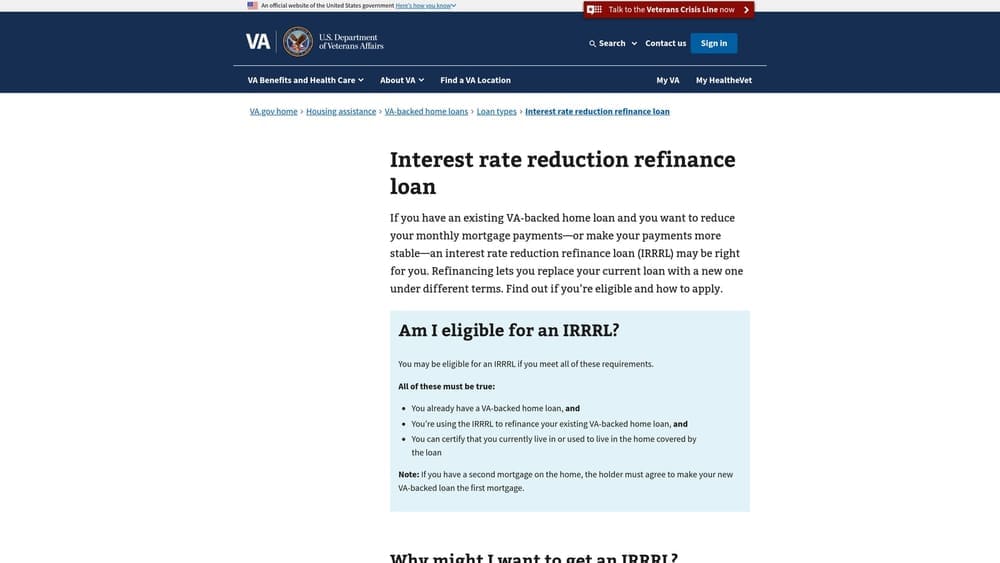
VA IRRRL is the VA’s own streamline refinance program — arguably the most powerful underwater refinance tool available because it carries no maximum LTV ceiling and typically requires no appraisal.
Where This Tool Shines
The VA IRRRL is uniquely constructed for underwater borrowers. Because the VA does not require an appraisal in most IRRRL cases and imposes no maximum LTV, a veteran who owes $400,000 on a home now worth $340,000 can still refinance — as long as they have an existing VA loan and are refinancing to a lower rate. The current home value is largely irrelevant to the approval decision.
This makes the IRRRL the first question any underwater veteran should ask. Before exploring conventional alternatives, the VA’s own streamline program is often the fastest, lowest-friction path to a lower payment. You can explore VA refinance rate options at mortgagerefinancerates.com/va-refinance-rates.
Key Features
No Maximum LTV: Refinance regardless of how deeply underwater the property is — the VA does not cap the loan-to-value ratio on IRRRL transactions.
No Appraisal Required (Most Cases): The home’s current market value does not factor into most IRRRL approvals, eliminating a major barrier for underwater borrowers.
No Income Verification (Most Cases): Streamlined documentation requirements mean most borrowers do not need to re-verify income or employment.
Rate Reduction Requirement: Must result in a lower interest rate — with limited exceptions for ARM-to-fixed conversions where a rate increase may be permitted.
Funding Fee: A VA funding fee applies but may be financed into the loan balance; veterans with service-connected disability ratings are typically exempt.
Best For
Veterans with existing VA loans who are significantly underwater and want the fastest, lowest-documentation path to a lower rate and payment. Especially strong for borrowers who cannot qualify for conventional programs due to LTV constraints.
Pricing
Government program with no cost from the VA. Lender fees and VA funding fee apply; funding fee can typically be financed into the loan balance.
3. FHA Streamline Refinance
Best for: Existing FHA borrowers who are underwater and want to lower their rate without an appraisal or income verification.
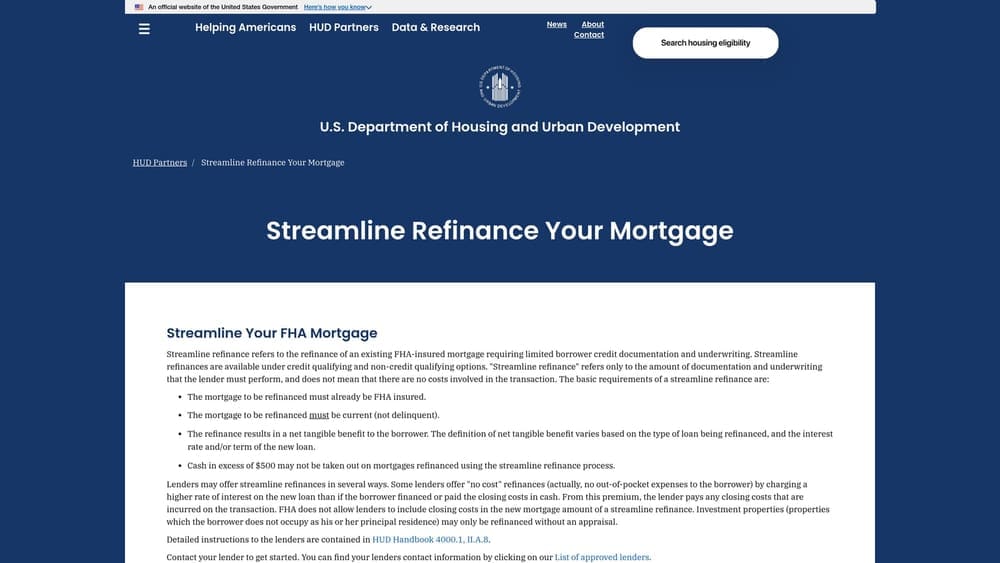
FHA Streamline Refinance is HUD’s streamline refinance program for existing FHA borrowers — the home’s current value is completely irrelevant, making it one of the most accessible underwater refinance solutions available in 2026.
Where This Tool Shines
The FHA Streamline’s defining feature for underwater borrowers is its appraisal waiver. Because HUD does not require a new appraisal, the current market value of the property has no bearing on approval. A borrower who purchased at peak pricing and now sits at 115% LTV can still qualify based on payment history and the net tangible benefit test — not on what their home is worth today.
The worked dollar example in the introduction of this article is an FHA Streamline scenario — $320,000 balance, 108% LTV, approximately $186 in monthly savings with a 19-month break-even. For borrowers who bought with FHA financing during a high-price period, this program is frequently the most direct path to payment relief. See current FHA Streamline rate options at mortgagerefinancerates.com/streamline-refinance-rates.
Key Features
No Appraisal: Current home value is not a factor — the program is designed specifically for borrowers who cannot benefit from a traditional appraisal-based refinance.
No Income Verification: Most FHA Streamline transactions do not require full income documentation, significantly reducing the documentation burden.
Net Tangible Benefit Required: HUD requires the refinance to produce a measurable benefit — typically a lower combined rate and MIP payment, or a shorter loan term.
On-Time Payment History: Borrower must be current on their existing FHA loan with a strong payment history — typically no late payments in the prior 12 months.
MIP Carries Over: Mortgage insurance premium continues on FHA Streamline transactions; it does not reset or disappear, which affects the net savings calculation.
Best For
FHA borrowers who purchased during a high-rate or high-price period and are now underwater. Particularly strong for borrowers in VA, FL, TN, and GA markets where home values have softened relative to purchase prices.
Pricing
Government program with no cost from HUD. Lender fees and ongoing MIP apply; some lenders offer lender credit structures to offset upfront closing costs.
4. Fannie Mae High LTV Refinance Option (HIRO)
Best for: Conventional borrowers with Fannie Mae-backed loans at LTV ratios above 97% who need a purpose-built underwater refinance program.
Fannie Mae HIRO is Fannie Mae’s purpose-built program for underwater conventional borrowers — no maximum LTV applies to eligible loans, and the program was specifically designed for homeowners who owe more than their property is worth.
Where This Tool Shines
HIRO fills a gap that conventional refinancing cannot address. Standard conventional programs typically cap LTV at 97% for rate-and-term refinances, which immediately disqualifies borrowers who are underwater. HIRO removes that ceiling entirely for eligible Fannie Mae-backed loans, allowing borrowers to refinance based on rate improvement rather than equity position.
The catch is specificity: the borrower’s existing loan must be backed by Fannie Mae (not Freddie Mac, FHA, VA, or USDA), and it must have been originated on or after October 1, 2017. Borrowers who are not sure whether their loan is Fannie Mae-backed can ask their servicer directly or request a loan lookup — a wholesale broker can also run this check during the no hard inquiry mortgage pre approval process.
Key Features
No Maximum LTV: No ceiling on loan-to-value ratio for eligible Fannie Mae-backed loans — designed specifically for underwater conventional borrowers.
Fannie Mae Loan Required: Existing loan must be backed by Fannie Mae; Freddie Mac loans use the parallel FMERR program instead.
Origination Date Requirement: Loan must have been originated on or after October 1, 2017 — loans before this date are not eligible.
LTV Must Exceed 97%: Borrowers with LTV at or below 97% do not qualify — HIRO is specifically for borrowers above that threshold.
Available Through Approved Lenders: HIRO is accessible through approved lenders and wholesale brokers — not all retail lenders participate, making broker access particularly valuable.
Best For
Conventional homeowners with Fannie Mae-backed loans originated after October 2017 who have seen their equity erode and cannot qualify for standard rate-and-term refinancing due to LTV constraints.
Pricing
Conventional program with no cost from Fannie Mae. Standard lender fees apply; lender credit structuring may be available through wholesale broker channel.
5. Freddie Mac Enhanced Relief Refinance (FMERR)
Best for: Conventional borrowers with Freddie Mac-backed loans above 97% LTV who need the Freddie-specific parallel to HIRO.
Freddie Mac FMERR is Freddie Mac’s high-LTV relief refinance program — structurally parallel to HIRO but designed for borrowers whose existing loans are backed by Freddie Mac rather than Fannie Mae.
Where This Tool Shines
FMERR and HIRO are mirror programs serving different loan pools. The key difference is the backing agency — if your existing loan is a Freddie Mac loan, HIRO does not apply to you, and FMERR does. Many borrowers do not know which GSE backs their loan, which is one reason working with a wholesale broker is particularly useful: the broker can identify the backing agency and route the file to the correct program without requiring the borrower to navigate the distinction independently.
Like HIRO, FMERR allows refinancing with no maximum LTV ceiling, meaning a borrower significantly underwater on a Freddie-backed loan can still access a lower rate and lower payment based on the rate improvement alone, without the home’s current value being a disqualifying factor.
Key Features
No Maximum LTV: No LTV ceiling for eligible Freddie Mac loans — borrowers significantly underwater can still qualify based on rate improvement.
Freddie Mac Loan Required: Existing loan must be backed by Freddie Mac; Fannie Mae loans use HIRO instead.
Origination Date Requirement: Loan must have been originated after November 1, 2018 — earlier originations are not eligible.
Rate or Term Reduction Only: FMERR is a rate-and-term program — no cash-out is permitted, which keeps the focus on payment relief rather than equity extraction.
Available Through Approved Lenders: Accessible through approved lenders and wholesale brokers; not all retail lenders participate in FMERR.
Best For
Conventional borrowers with Freddie Mac-backed loans originated after November 2018 who are underwater and need a path to lower rate and payment without meeting standard LTV requirements.
Pricing
Conventional program with no cost from Freddie Mac. Standard lender fees apply; wholesale broker access may enable lender credit structuring to offset closing costs.
6. USDA Streamlined-Assist Refinance
Best for: Rural homeowners with existing USDA loans in eligible areas of VA, FL, TN, or GA who want a streamline refinance with minimal credit review.
USDA Streamlined-Assist is the USDA’s streamline refinance option for rural homeowners with existing USDA loans — no appraisal, minimal credit review, and 12 months of on-time payments as the primary qualifier.
Where This Tool Shines
The USDA Streamlined-Assist is the least-discussed program on this list, but for eligible borrowers it is remarkably accessible. Because the program does not require a new appraisal and typically does not involve a formal credit score review, underwater borrowers in USDA-eligible rural areas can qualify based almost entirely on payment history. If you have made 12 consecutive on-time payments on your existing USDA loan, you are likely eligible to apply.
The geographic requirement is the primary constraint. USDA-eligible areas exist within Virginia, Florida, Tennessee, and Georgia — including rural and semi-rural communities that are often overlooked in refinance conversations. A wholesale broker familiar with USDA program geography can quickly confirm whether a property address qualifies.
Key Features
No Appraisal Required: Current home value does not factor into the approval — the program bypasses the appraisal requirement entirely.
No Credit Score Review (Most Cases): Unlike conventional programs, USDA Streamlined-Assist typically does not involve a formal credit score pull or review in the approval process.
12 Consecutive On-Time Payments: The primary qualifying criterion — borrowers must demonstrate 12 months of on-time payments on the existing USDA loan.
Minimum $50/Month Payment Reduction: The refinance must reduce the principal and interest payment by at least $50 per month — a net tangible benefit requirement similar to FHA Streamline.
USDA-Eligible Areas Only: Property must be located in a USDA-designated rural area — eligibility can be confirmed through the USDA’s online property eligibility tool.
Best For
Rural homeowners in Virginia, Florida, Tennessee, or Georgia with existing USDA loans who are underwater and want a streamlined path to lower payment with minimal documentation and no appraisal barrier.
Pricing
Government program with no cost from USDA. A guarantee fee applies and may be financed into the loan; lender fees vary by originator.
7. Rate-and-Term Refi with Wholesale Lender Credit Strategy
Best for: Borrowers marginally underwater on conventional loans (LTV 100–105%) who have a clear rate improvement available but cannot bring cash to closing.
MortgageRefinanceRates.com structures rate-and-term refinances using wholesale lender credits to offset closing costs — making refinancing accessible for borrowers slightly above their home’s value without requiring out-of-pocket cash or rolling costs into a higher balance.
Where This Tool Shines
Not every underwater borrower is dramatically underwater. A borrower at 103% LTV on a conventional loan who has a meaningful rate improvement available faces a different problem than a borrower at 120% LTV: they might technically qualify for a refinance, but they cannot bring $5,000 to closing and they do not want to roll costs into a higher balance when they are already above water. The lender credit strategy solves this specific problem.
Through the wholesale channel, a broker can price a loan slightly above the par rate — the rate at which the lender earns no premium — and use the resulting lender credit to cover origination fees, title, and escrow costs. The borrower pays a slightly higher rate than they would with a traditional closing cost structure, but they pay nothing out of pocket. This is a pricing trade-off, not a free lunch, and it works best when the rate improvement is substantial enough that the slightly-above-par rate still represents a significant improvement over the current rate.
Key Features
Lender Credit Covers Closing Costs: Wholesale pricing allows the broker to generate lender credit that offsets origination fees, title, and escrow — no cash to close required.
Wholesale Pricing Advantage: Retail lenders like Rocket Mortgage, Veterans United, and Movement Mortgage cannot match the lender credit structuring available through the wholesale channel due to pricing layer differences.
Rate Trade-Off Transparency: The borrower accepts a slightly higher rate in exchange for the lender credit — this is disclosed clearly and is not a hidden cost structure.
Best for Marginal Underwater Situations: Most effective for borrowers at LTV 100–105% where a conventional program may still apply but closing cost access is the barrier.
Wholesale Channel Only: This structuring approach is not available through retail lenders — it requires access to wholesale pricing tiers where lender credits can be generated at sufficient levels to cover closing costs.
Best For
Conventional borrowers slightly above their home’s value who have a clear rate improvement available but are cash-constrained at closing. Also useful for borrowers who want to avoid a no hard inquiry mortgage pre approval situation turning into a hard pull before they confirm the deal pencils out.
Pricing
No out-of-pocket closing costs when structured with lender credit; the trade-off is a rate slightly above par. Net savings depend on the spread between current rate and new rate.
8. VA Cash-Out Refinance to 100% LTV
Best for: Veterans near or at their home’s current value who want to consolidate debt or access equity at VA rates with the highest LTV ceiling available.
VA Cash-Out Refinance allows eligible veterans to refinance to 100% LTV — the highest ceiling of any government program — making it relevant even for borrowers near or at their home’s current value, and particularly powerful for debt consolidation scenarios. Learn more about VA loan refinance options at mortgagerefinancerates.com/va-loan-refinance-options-for-veterans.
Where This Tool Shines
The VA cash-out program is frequently misunderstood. Many borrowers and even some lenders quote a 90% LTV ceiling on VA cash-out — that figure is incorrect. The VA allows cash-out refinancing to 100% LTV. For a veteran whose home is worth $300,000 and who currently owes $295,000, that means a full refinance is possible, and in a debt consolidation scenario, the veteran could potentially pay off high-interest credit card or auto debt using the transaction structure.
There is one meaningful distinction from the IRRRL: the VA cash-out program requires a full appraisal. The home’s current value matters here because the 100% LTV ceiling is calculated against the appraised value. A borrower who owes $310,000 on a home appraised at $300,000 cannot use the cash-out program — but a borrower at exactly $300,000 or below can. The VA cash-out also allows a Type I transaction, which lets a veteran refinance a non-VA loan into a VA loan, potentially opening this program to veterans who currently have FHA or conventional financing.
Key Features
100% LTV Ceiling: Not 90%, not 95% — 100% LTV is the actual program ceiling for VA cash-out refinance transactions.
Type I Cash-Out (Non-VA to VA): Veterans can refinance out of a non-VA loan and into a VA loan using the cash-out structure, expanding eligibility significantly.
Debt Consolidation Use Case: The cash-out structure allows veterans to pay off high-interest debt at VA rates, which are typically lower than credit card or personal loan rates.
Full Appraisal Required: Unlike the IRRRL, the cash-out program requires a full appraisal — home value must support the 100% LTV calculation.
VA Funding Fee: Applies to most transactions; veterans with service-connected disability ratings are typically exempt from the funding fee entirely.
Best For
Veterans at or near 100% LTV who want to consolidate high-interest debt, convert a non-VA loan to a VA loan, or access whatever equity exists at the highest LTV ceiling available in any government program. Licensed in VA, FL, TN, GA through Duane Buziak, NMLS #1110647.
Pricing
Government program with no cost from the VA. Lender fees and VA funding fee apply; funding fee exemption available for veterans with qualifying disability ratings.
How the Programs Stack Up: Side-by-Side Comparison
According to the Freddie Mac Primary Mortgage Market Survey, which tracks weekly average 30-year fixed rates nationally, rate movements in 2026 have created meaningful refinance opportunities for borrowers who previously had no viable path due to LTV constraints. The programs below represent the primary structured solutions for underwater borrowers.
| Program | LTV Ceiling | Appraisal Required? | Income Verification? | Existing Loan Required? | Best For |
|---|---|---|---|---|---|
| VA IRRRL | None (unlimited) | No (most cases) | No (most cases) | Yes — existing VA loan | Underwater veterans seeking fastest rate reduction |
| FHA Streamline | None (unlimited) | No | No | Yes — existing FHA loan | FHA borrowers who purchased at peak pricing |
| HIRO (Fannie Mae) | None (above 97%) | Yes | Yes | Yes — existing Fannie Mae loan | Conventional borrowers with Fannie-backed loans |
| FMERR (Freddie Mac) | None (above 97%) | Yes | Yes | Yes — existing Freddie Mac loan | Conventional borrowers with Freddie-backed loans |
| USDA Streamlined-Assist | None (unlimited) | No | No | Yes — existing USDA loan | Rural homeowners in USDA-eligible areas |
| Conventional + Lender Credit | ~105% LTV | Yes | Yes | No | Marginally underwater conventional borrowers |
| VA Cash-Out | 100% LTV | Yes | Yes | No (Type I allows non-VA to VA) | Veterans near home value seeking debt consolidation |
Frequently Asked Questions
What does it mean to be underwater on a mortgage?
Being underwater on a mortgage means your current loan balance exceeds your home’s current appraised market value — also called negative equity. For example, owing $320,000 on a home now worth $295,000 puts you underwater by $25,000, at an LTV of approximately 108%. This condition typically blocks standard refinancing because most conventional programs require the loan balance to be at or below the home’s value.
Can you refinance if you owe more than your home is worth?
Yes — several federal programs are specifically designed to allow refinancing regardless of current home value, including VA IRRRL, FHA Streamline, HIRO, FMERR, and USDA Streamlined-Assist. These programs either waive the appraisal requirement entirely or remove the LTV ceiling, making the home’s current market value irrelevant to the approval decision. Program eligibility depends on your existing loan type.
Does the VA IRRRL require an appraisal if I’m underwater?
No — the VA IRRRL does not require an appraisal in most cases, and it has no maximum LTV ceiling. This means veterans with existing VA loans can refinance to a lower rate regardless of how underwater the property is. The primary requirements are an existing VA loan and a refinance that results in a lower interest rate (with limited exceptions for ARM-to-fixed conversions).
What is the FHA Streamline Refinance and how does it help underwater borrowers?
The FHA Streamline Refinance is HUD’s streamlined refinance program for existing FHA borrowers that requires no appraisal and no income verification — making the home’s current market value completely irrelevant to approval. Underwater FHA borrowers qualify based on payment history and net tangible benefit (a lower rate or lower payment), not on what their home is currently worth. The mortgage insurance premium carries over, so net savings are calculated on the base rate reduction only.
What is the Fannie Mae HIRO program and who qualifies?
The Fannie Mae High LTV Refinance Option (HIRO) is a program specifically designed for conventional borrowers whose existing Fannie Mae-backed loans have LTV ratios above 97% — meaning they are underwater or near underwater. HIRO removes the LTV ceiling for eligible loans, allowing refinancing based on rate improvement rather than equity position. To qualify, the existing loan must be backed by Fannie Mae and must have been originated on or after October 1, 2017.
Can I do a VA cash-out refinance if I’m underwater?
The VA cash-out refinance allows refinancing to 100% LTV — not 90%, not 95%, but 100% LTV — making it available to veterans whose loan balance equals their home’s current appraised value. However, it does require a full appraisal, so the home’s value matters in the calculation. Veterans whose balance exceeds 100% of current value cannot use the cash-out program but may still qualify for the VA IRRRL, which has no LTV ceiling and typically requires no appraisal.
Will refinancing while underwater hurt my credit score?
A hard credit inquiry from a refinance application can temporarily affect your credit score, but the NoTouch Credit Pull process at MortgageRefinanceRates.com allows borrowers to explore program eligibility and rate scenarios using a soft credit pull mortgage approach — no hard inquiry, no credit score impact while shopping. This is especially important for underwater borrowers who are rate-sensitive and cannot afford score reductions while evaluating multiple programs. A no credit hit mortgage application is the right starting point for any underwater borrower who is unsure which program applies.
How do I find out which underwater refinance program I qualify for?
The fastest path is a mortgage pre approval without hard pull through a wholesale broker who has access to all major programs simultaneously. A wholesale broker can identify whether your existing loan is backed by Fannie Mae, Freddie Mac, FHA, VA, or USDA — and route your file to the correct program — without requiring a hard inquiry first. Retail lenders can only offer their own product shelf; a wholesale broker shops across 500+ lenders and programs in a single consultation. Borrowers in Virginia, Florida, Tennessee, and Georgia can start with a soft pull mortgage broker consultation at MortgageRefinanceRates.com.
Which Solution Fits Your Situation
The right underwater refinance solution depends almost entirely on your existing loan type. If you have a VA loan, the IRRRL is your first call — no appraisal, no LTV ceiling, fastest execution. If you have an FHA loan, the FHA Streamline is the direct path — current home value is irrelevant. Conventional borrowers need to identify their backing agency: Fannie Mae points to HIRO, Freddie Mac points to FMERR. Rural homeowners with USDA loans have the Streamlined-Assist option with minimal documentation. Veterans near 100% LTV with a debt consolidation need should evaluate the VA cash-out program specifically.
For borrowers who are not sure which program applies — or who have been told by a retail lender that they do not qualify — the wholesale broker channel is the practical next step. Retail lenders like Rocket Mortgage, Veterans United, and Movement Mortgage are limited to their own product shelves. A wholesale broker with access to 500+ lenders shops all of the above programs simultaneously, finding the lender and program that fits rather than delivering a single answer based on a single product set.
The FHFA House Price Index tracks home value trends that directly affect LTV calculations — and for borrowers in markets where values have softened, the programs in this guide represent the primary structured relief available. If you are in Virginia, Florida, Tennessee, or Georgia and want to know which program applies to your loan, start with a no credit hit mortgage application through the NoTouch Credit Pull process. No hard inquiry, no commitment, no risk to your score while you evaluate your options.
Compare personalized refinance rates now and find out which underwater refinance program applies to your loan — licensed in VA, FL, TN, and GA through Duane Buziak, NMLS #1110647 | Coast2Coast Mortgage LLC, NMLS #376205. Phone: 804-212-8663.
For additional context on refinance timing, see when to refinance your mortgage and what credit score is needed to refinance.

