


When you’re preparing to refinance, the documents and steps you organize upfront determine how fast you close — and at what rate. A disorganized application slows underwriting, invites conditions, and can cost you a rate lock. Whether you’re pursuing a rate-and-term refi, VA IRRRL, FHA Streamline, or cash-out, the right tools make the difference between a 21-day close and a 45-day scramble.
Refinance borrowers in Virginia, Florida, Tennessee, and Georgia are increasingly using a combination of government resources, GSE calculators, and wholesale broker platforms to organize their applications before a single lender sees their file. According to the Freddie Mac Primary Mortgage Market Survey, refinance activity responds quickly to rate movements — which means borrowers who are already organized can lock faster when rates dip.
Here are the top tools for your refinance application checklist in 2026, ranked by direct relevance to the refinance process, data accuracy, and borrower-facing usability.
By Duane Buziak, NMLS #1110647 | Coast2Coast Mortgage LLC, NMLS #376205
1. MortgageRefinanceRates.com (Coast2Coast Mortgage LLC)
Best for: Refinance borrowers in VA, FL, TN, and GA who want wholesale rate access without a hard credit pull.
MortgageRefinanceRates.com is a wholesale mortgage broker portal serving refinance borrowers across Virginia, Florida, Tennessee, and Georgia.
Where This Tool Shines
The core advantage here is structural, not cosmetic. A retail lender like Rocket Mortgage, Veterans United, or Movement Mortgage can only offer rates from their own shelf. MortgageRefinanceRates.com, operating as Coast2Coast Mortgage LLC, sources pricing from 500+ wholesale lenders — meaning the rate you receive is competitively bid across a wide market, not a single company’s posted rate.
The other standout feature is NoTouch Credit Pull. Most lenders trigger a hard inquiry the moment you apply. This broker uses a soft credit pull mortgage process to generate real rate quotes before any hard pull is initiated. That means you can evaluate actual numbers — not ballpark estimates — without a no hard inquiry mortgage pre approval affecting your credit score. For borrowers comparison shopping across multiple programs, that protection matters.
Key Features
NoTouch Credit Pull: Generates real rate quotes using a soft pull mortgage process — no hard inquiry triggered at the quote stage, protecting your credit score while you shop.
500+ Wholesale Lenders: Rate is sourced competitively across hundreds of wholesale lenders rather than one retail shelf, creating a structural pricing advantage over direct-to-consumer lenders.
VA Cash-Out to 100% LTV: VA cash-out refinance is available to 100% LTV — the full extent of the VA program rule — not capped at a lower internal lender limit.
Full Program Menu: Covers rate-and-term, cash-out, VA IRRRL, FHA Streamline, jumbo refi, and debt consolidation refinance — borrowers don’t need to shop different lenders for different programs.
Licensed States: Operates in VA, FL, TN, and GA. All rate quotes and applications are handled by Duane Buziak, NMLS #1110647, under Coast2Coast Mortgage LLC, NMLS #376205.
Best For
Refinance borrowers in Virginia, Florida, Tennessee, or Georgia who want to compare wholesale pricing across multiple programs without triggering hard inquiries. Particularly strong for VA borrowers, FHA borrowers considering a Streamline, and cash-out applicants who want to understand their LTV position before committing to an application.
Pricing
No application fee for a rate quote. Wholesale lender credit options are available depending on the program and loan structure. Call 804-212-8663 to discuss your scenario.
2. CFPB Loan Estimate Explainer Tool
Best for: Refinance borrowers comparing multiple lender quotes line by line without guessing at terminology.
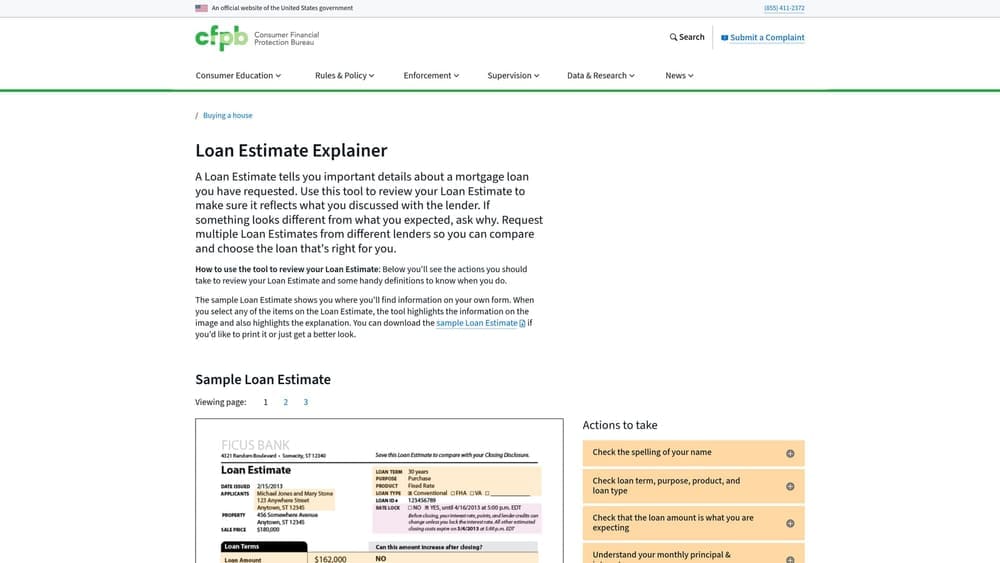
CFPB Loan Estimate Explainer is a government-sourced interactive guide that walks borrowers through every field on a lender-issued Loan Estimate.
Where This Tool Shines
When you receive competing Loan Estimates from multiple lenders, the document can look deceptively similar across the page. The CFPB’s tool breaks down every line — origination charges, APR versus interest rate, prepaid items, rate lock terms, and cash to close — so you understand what you’re actually comparing.
This is especially useful for refinance borrowers who are seeing their first Loan Estimate or who received quotes from both a retail lender and a wholesale broker. The structural differences in lender fees and rate lock terms become much clearer when you know what each field means.
Key Features
Field-by-Field Breakdown: Explains every section of the standardized Loan Estimate, including origination charges, services you can and cannot shop for, and escrow calculations.
APR vs. Interest Rate Clarity: Clarifies why the APR and interest rate differ — critical for comparing refi quotes that bundle fees differently.
Rate Lock Explanation: Covers what rate lock periods mean and what happens if your lock expires before closing.
No Data Submitted: Completely passive — no login, no personal information entered, no tracking beyond standard government site analytics.
Best For
Any refinance borrower who has received one or more Loan Estimates and wants to understand exactly what they’re comparing before signing anything or making a lender decision.
Pricing
Free — published by the Consumer Financial Protection Bureau. No account required.
3. AnnualCreditReport.com
Best for: Reviewing all three credit bureau reports for errors before any lender sees your file.
AnnualCreditReport.com is the federally mandated free credit report portal, authorized under the Fair Credit Reporting Act, that gives borrowers direct access to their Equifax, Experian, and TransUnion reports.
Where This Tool Shines
This is the right first step before any soft credit pull mortgage or no credit hit mortgage application process begins. Errors on credit reports — duplicate accounts, incorrect balances, accounts that aren’t yours — are more common than most borrowers expect, and a single reporting error can suppress your score enough to push you into a higher rate tier.
Pulling your own reports here generates no hard inquiry. You’re reviewing the raw data before any lender does, which gives you time to dispute errors through the bureau’s formal process. Resolving a dispute before your application can meaningfully improve your score and the rate you qualify for.
Key Features
Three-Bureau Access: Pulls reports from Equifax, Experian, and TransUnion simultaneously — since lenders typically use a tri-merge report, you need to review all three.
No Hard Inquiry: Accessing your own report through this portal does not generate a hard inquiry and does not affect your credit score.
Dispute Pathway: Each bureau’s report links directly to their dispute process, allowing you to flag errors before a lender pulls your file.
FCRA-Mandated: This is not a third-party aggregator — it is the legally designated free access point under federal law.
Best For
Every refinance borrower, without exception, should use this tool before beginning any application. It is particularly critical for borrowers who haven’t checked their credit in over a year or who suspect errors from closed accounts or old collections.
Pricing
Free — federally mandated access under the Fair Credit Reporting Act. No account required.
4. FHFA House Price Index Calculator
Best for: Estimating current home value trends by metro area to calculate LTV before applying for cash-out or jumbo refi.
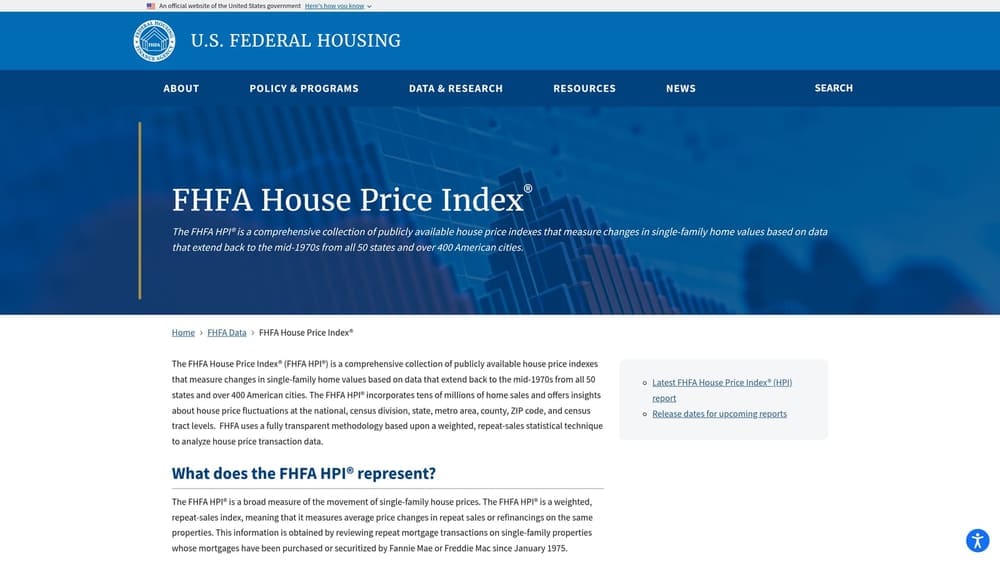
FHFA House Price Index is the Federal Housing Finance Agency’s data tool that tracks home price appreciation by metro area using actual mortgage transaction data.
Where This Tool Shines
Before you order a full appraisal or submit a cash-out refinance application, you need a realistic sense of your home’s current value and your resulting LTV. Consumer AVM tools like Zillow’s Zestimate are widely available but tend to be more volatile and less conservative than what lenders actually weight. The FHFA HPI uses real mortgage transaction data — the same underlying data source lenders reference when stress-testing appraisals.
This tool is also the right place to confirm whether your loan amount falls under the 2026 conforming limit. The baseline conforming limit for 2026 is $806,500, with high-cost area limits up to $1,249,125. If your post-refi loan balance exceeds those thresholds, you’re looking at a jumbo refinance with different underwriting requirements.
Key Features
Metro-Level HPI Data: Tracks home price appreciation by metropolitan statistical area — more granular than national averages and more relevant to your actual property.
LTV Estimation: Helps cash-out refi borrowers estimate available equity and LTV before committing to an appraisal fee.
2026 Conforming Limit Reference: Confirms whether your loan amount stays within the $806,500 baseline or $1,249,125 high-cost conforming limits.
Conservative Benchmark: FHFA data is more lender-aligned than consumer AVM tools — gives a more realistic pre-application picture.
Best For
Cash-out refinance borrowers estimating available equity, jumbo refi borrowers confirming loan amount thresholds, and any borrower who wants a lender-relevant home value benchmark before ordering an appraisal.
Pricing
Free — published by the Federal Housing Finance Agency. No account required.
5. VA.gov IRRRL Eligibility Resource
Best for: Veterans and service members confirming IRRRL eligibility, funding fee status, and VA cash-out LTV rules directly from the source.
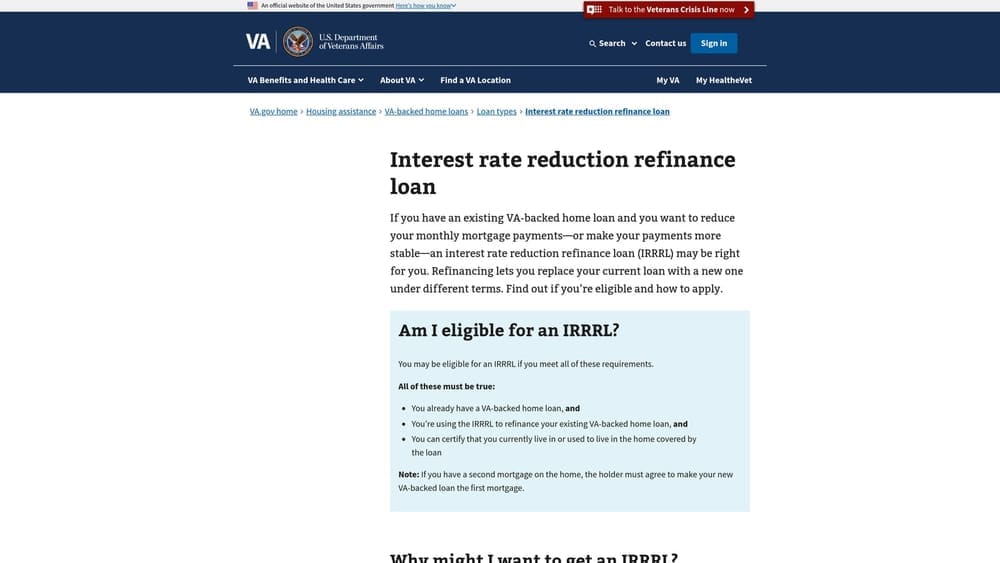
VA.gov IRRRL Resource is the official Department of Veterans Affairs page covering Interest Rate Reduction Refinance Loan eligibility, net tangible benefit requirements, and VA cash-out refinance rules.
Where This Tool Shines
There is a significant amount of misinformation about VA refinance programs circulating through retail lender marketing. The VA.gov resource cuts through that by providing the authoritative program rules — including the frequently misquoted VA cash-out LTV ceiling. VA cash-out refinance allows borrowing up to 100% LTV. Not 90%. Not 95%. The VA program allows 100% LTV, and borrowers should verify this directly on VA.gov rather than accepting a retail lender’s more restrictive internal cap as the program rule.
The IRRRL (commonly called the VA streamline) has its own requirements: a net tangible benefit to the borrower, specific funding fee rules, and Certificate of Eligibility requirements. Retail lenders like Veterans United and Rocket Mortgage access the same VA program — but at retail pricing. Reviewing the program rules directly on VA.gov before any lender conversation puts you in a stronger negotiating position.
Key Features
IRRRL Eligibility Rules: Covers the net tangible benefit requirement, occupancy rules, and which existing VA loans qualify for the streamline process.
VA Cash-Out at 100% LTV: Confirms the 100% LTV ceiling on VA cash-out refinance — the actual VA program rule, not a lender’s internal restriction.
Funding Fee Details: Lists funding fee percentages and exemptions — veterans with service-connected disabilities may be exempt.
COE Guidance: Explains Certificate of Eligibility verification and how to confirm your entitlement status before applying.
Best For
Any veteran, active-duty service member, or surviving spouse exploring a VA IRRRL or VA cash-out refinance. Essential reading before any lender conversation, particularly for borrowers who have been told their VA cash-out LTV is capped below 100%.
Pricing
Free — official U.S. Department of Veterans Affairs resource. No account required.
6. HUD FHA Streamline Refinance Resource Page
Best for: Existing FHA borrowers confirming no-appraisal eligibility, MIP timelines, and seasoning requirements before applying.
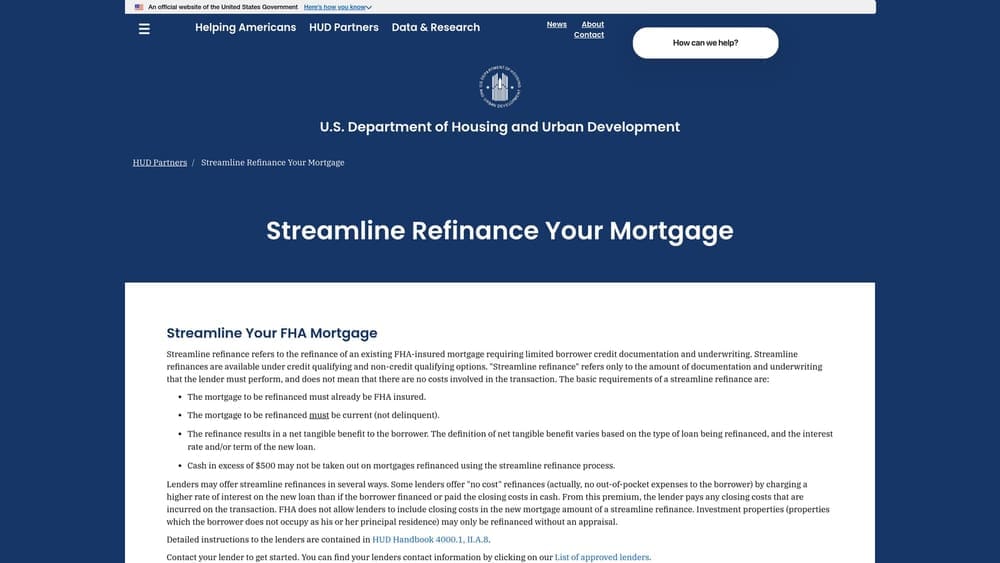
HUD FHA Streamline Refinance Page is the U.S. Department of Housing and Urban Development’s authoritative guidance on reduced-documentation FHA refinance rules.
Where This Tool Shines
FHA Streamline refinances are one of the most misunderstood programs in the refinance market. Lender marketing often glosses over the specific seasoning requirements and MIP rules that determine whether a Streamline actually saves a borrower money. HUD’s official page provides the actual program parameters — not a lender’s simplified summary.
The key eligibility thresholds: borrowers must have made at least 6 payments on the existing FHA loan, and the loan must be at least 210 days old at the time of application. The no-appraisal, reduced-documentation structure makes this one of the fastest refi programs available for qualifying FHA borrowers — but only if you meet the seasoning requirements and the MIP math works in your favor.
Key Features
No-Appraisal Eligibility: Confirms which FHA borrowers qualify for the streamlined process without a new appraisal — significantly reducing upfront costs and closing timelines.
Seasoning Requirements: Documents the 6-payment and 210-day minimum requirements that must be met before application.
MIP Rules: Covers mortgage insurance premium reduction eligibility and how MIP affects the net benefit calculation.
HUD-Authoritative: This is the program source document — not a lender’s marketing summary — so borrowers can verify what they’re being told by lenders.
Best For
Existing FHA borrowers who want to verify Streamline eligibility before applying, particularly those who have been told conflicting information by lenders about appraisal requirements or MIP savings.
Pricing
Free — official HUD resource. No login required.
7. Freddie Mac Refinance Break-Even Calculator
Best for: Rate-and-term refi borrowers calculating exactly how many months it takes to recover closing costs through monthly savings.
Freddie Mac’s Refinance Calculator uses GSE-backed amortization logic to produce a clear break-even analysis for refinance borrowers.
Where This Tool Shines
The break-even question is the central math problem of any rate-and-term refinance: how long do I need to stay in this home for the refi to pay off? Generic online calculators often use simplified assumptions that produce optimistic results. Freddie Mac’s calculator uses the same amortization logic that underlies GSE underwriting — making it a more reliable benchmark than most consumer-facing tools.
Here’s how the math works in practice. On a $350,000 loan at 7.25% (30-year fixed), the principal and interest payment is approximately $2,388 per month. Refinancing to 6.50% drops that payment to approximately $2,212 — a savings of roughly $176 per month. With estimated closing costs of $5,500, the break-even point is approximately 31 months, or about 2.6 years. A borrower planning to stay 5 or more years would recover the closing costs and generate meaningful ongoing savings. This is illustrative arithmetic; actual rates and closing costs vary by borrower profile, program, and market conditions.
Key Features
Break-Even Output: Shows the exact month when cumulative savings exceed closing costs — the core decision metric for rate-and-term refi borrowers.
Monthly Savings Calculation: Computes the difference in principal and interest payments between current and proposed loan terms.
Closing Cost Input: Allows borrowers to enter their actual or estimated closing costs for a personalized break-even result.
GSE-Backed Logic: Uses amortization methodology consistent with Freddie Mac’s underwriting standards — more reliable than generic mortgage calculators.
Best For
Rate-and-term refinance borrowers who want to verify that the math justifies the refi before submitting an application. Also useful for debt consolidation refi borrowers comparing monthly savings against total cost.
Pricing
Free — GSE resource published by Freddie Mac. No account required.
8. IRS Get Transcript Tool
Best for: Refinance borrowers pre-staging income documentation to eliminate underwriting delays.
IRS Get Transcript is the IRS’s official portal for borrowers to pull their own tax transcripts — including 1040, W-2, and 1099 records — instantly and digitally.
Where This Tool Shines
Income documentation is one of the most common sources of underwriting delays in refinance applications. Lenders are required to verify income through IRS Form 4506-C, which authorizes them to pull transcripts directly from the IRS. Having your own transcripts already pulled and organized before your first lender conversation gives underwriting a head start and reduces the likelihood of conditions being issued mid-process.
For self-employed borrowers, this tool is especially valuable. Complex income with Schedule C, Schedule E, or K-1 distributions can create significant back-and-forth between underwriters and borrowers. Pulling your own transcripts first lets you identify any discrepancies between what you filed and what a lender will see — before the application clock is running.
Key Features
Instant Digital Delivery: Tax transcripts are available immediately for most filers through the IRS online portal — no waiting for paper mail.
Satisfies 4506-C Requirements: Lenders accept IRS transcripts directly; having them ready accelerates the underwriting income verification step.
Multiple Transcript Types: Access 1040 return transcripts, wage and income transcripts (W-2, 1099), and account transcripts — covering the full range of income documentation lenders typically require.
Secure Access: Requires ID.me verification — the same identity verification used across federal agencies — protecting your tax data.
Best For
All refinance borrowers, with particular value for self-employed borrowers, those with multiple income sources, and anyone who wants to accelerate underwriting by pre-staging income documentation before the application is submitted.
Pricing
Free — official IRS resource. Requires ID.me account for secure login.
9. Fannie Mae Loan Lookup Tool
Best for: Borrowers confirming Fannie Mae loan ownership to determine HIRO eligibility for high-LTV refinance scenarios.
Fannie Mae Loan Lookup is an instant, no-login tool that confirms whether Fannie Mae currently owns your mortgage — a critical eligibility step for the High LTV Refinance Option (HIRO).
Where This Tool Shines
Many borrowers who believe they have limited equity — or who are near underwater — assume they can’t refinance. The HIRO program exists specifically for Fannie Mae-owned loans with LTVs that exceed standard conventional limits. But HIRO eligibility begins with one question: does Fannie Mae own your loan? This tool answers that in seconds, with no login and no data submitted beyond your address and last four digits of your Social Security number.
If Fannie Mae doesn’t own your loan, the Freddie Mac equivalent lookup covers the other GSE. Together, these two tools tell you whether you have access to high-LTV refinance programs that aren’t available through standard conventional underwriting — which is particularly relevant for borrowers in markets where values have softened since their original purchase.
Key Features
Instant Loan Ownership Confirmation: Returns a result in seconds — no lender intermediary needed to determine whether Fannie Mae owns your mortgage.
HIRO Eligibility Gateway: HIRO allows refinancing even when LTV exceeds standard conforming limits — this lookup is the required first step to determine eligibility.
No Account Required: Completely frictionless — no login, no saved data, no marketing follow-up from the lookup itself.
GSE Coverage Pairing: Use alongside Freddie Mac’s equivalent lookup to confirm whether either GSE owns your loan and which high-LTV programs may apply.
Best For
Refinance borrowers who believe they have limited equity, are near underwater, or have been told by a retail lender that they don’t qualify for a conventional refi due to LTV. Also useful for any borrower who simply doesn’t know who owns their current mortgage.
Pricing
Free — GSE resource published by Fannie Mae. No account required.
Broker vs. Retail Lender: How the Rates Stack Up
Understanding why wholesale broker pricing differs from retail lender pricing requires looking at the structural differences side by side. Here’s how MortgageRefinanceRates.com compares to three major retail lenders on the key dimensions that affect your refinance outcome.
| Lender | Rate Source | Lender Fees | Cash-Out LTV Ceiling | Program Access | Credit Pull Type | Est. Closing Timeline |
|---|---|---|---|---|---|---|
| MortgageRefinanceRates.com | 500+ wholesale lenders | Wholesale pricing | VA: 100% LTV / Conv: 80% | Rate-and-term, cash-out, VA IRRRL, FHA Streamline, jumbo, debt consolidation | NoTouch Soft Pull | Typically 21–30 days |
| Rocket Mortgage | Single retail shelf | Retail pricing | Conv: 80% | Limited retail program set | Hard pull at application | Varies |
| Veterans United | Single retail shelf | Retail pricing | VA: 100% LTV | VA-focused programs | Hard pull at application | Varies |
| Movement Mortgage | Single retail shelf | Retail pricing | Conv: 80% | Standard retail programs | Hard pull at application | Varies |
The key structural difference: a soft pull mortgage broker sources your rate competitively across hundreds of wholesale lenders, while a retail lender offers one shelf. A mortgage pre approval without hard pull — like the NoTouch process at MortgageRefinanceRates.com — also means you can receive a real rate quote before any hard inquiry appears on your credit report.
Frequently Asked Questions
What documents do I need for a refinance application checklist?
A standard refinance application checklist includes your two most recent pay stubs, two years of W-2s or tax returns, two months of bank statements, a current mortgage statement, homeowners insurance declarations page, and a government-issued ID. Self-employed borrowers typically also need business tax returns and a year-to-date profit and loss statement. Pulling your IRS transcripts in advance using the IRS Get Transcript tool can eliminate delays during underwriting income verification.
How does a wholesale broker differ from a retail lender on a refinance application?
A wholesale broker submits your application to multiple wholesale lenders and receives competitively priced rate quotes, while a retail lender can only offer rates from their own product shelf. The structural result is that wholesale broker pricing is typically more competitive than a single retail lender’s posted rate — because the rate is being sourced across a broader market rather than from one institution’s pricing engine.
Can I get a refinance rate quote without a hard credit pull?
Yes — a no hard inquiry mortgage pre approval is available through wholesale brokers that use soft pull processes. MortgageRefinanceRates.com uses NoTouch Credit Pull, which generates real rate quotes from wholesale lenders using a soft credit pull mortgage process that does not trigger a hard inquiry on your credit report. This protects your score while you compare options.
What is the NoTouch Credit Pull and how does it protect my credit score?
NoTouch Credit Pull is the soft pull mortgage broker process used by MortgageRefinanceRates.com (Coast2Coast Mortgage LLC) to generate real refinance rate quotes without initiating a hard inquiry. A hard inquiry typically reduces your credit score by a few points and remains visible to future lenders for two years. The NoTouch process uses a soft pull — which is not visible to other lenders and does not affect your score — allowing you to receive actual rate quotes before committing to a full application.
How do I check my home’s value before a cash-out refinance?
The most lender-relevant pre-application estimate comes from the FHFA House Price Index tool at fhfa.gov/data/hpi, which uses actual mortgage transaction data by metro area. Consumer AVM tools are available but tend to be more volatile than what lenders actually reference. After reviewing FHFA data, your lender will order a formal appraisal — but using the FHFA HPI first helps you estimate your LTV and available equity before paying for an appraisal.
What is the 2026 FHFA conforming loan limit and how does it affect my refinance?
The 2026 FHFA conforming loan limit is $806,500 for most U.S. counties, with high-cost area limits up to $1,249,125. If your post-refinance loan balance exceeds the applicable limit for your county, your loan is classified as a jumbo refinance, which carries different underwriting requirements, typically higher FICO minimums, and different rate pricing than conforming loans. Use the FHFA HPI tool to confirm which limit applies to your property location.
Can I do a VA IRRRL or VA cash-out refinance to 100% LTV?
Yes — VA cash-out refinance allows borrowing up to 100% LTV under the VA program rules, as confirmed on VA.gov. This is not a lender-specific policy; it is the VA program ceiling. Some retail lenders impose more restrictive internal LTV caps, so borrowers should verify the actual program rule on VA.gov and confirm that their lender is not applying a lower cap. The VA IRRRL (streamline) has separate eligibility requirements, including a net tangible benefit to the borrower and a valid Certificate of Eligibility.
How long does it take to break even on a refinance?
Break-even on a refinance is calculated by dividing total closing costs by monthly payment savings. For example, on a $350,000 loan refinanced from 7.25% to 6.50% (30-year fixed), monthly savings are approximately $176. With $5,500 in closing costs, the break-even point is approximately 31 months — about 2.6 years. Borrowers who plan to stay in the home beyond that point benefit from the refi; those planning to sell or refinance again sooner may not recover the closing costs. Use the Freddie Mac refinance calculator at freddiemac.com/research/calculators to run your specific numbers.
Which Tool Is Right for Your Refinance Situation
Your refinance application checklist is only as strong as the tools behind it. The sequence matters as much as the tools themselves.
Start with AnnualCreditReport.com to review your credit before any lender sees your file. Use the FHFA HPI calculator to estimate your LTV and confirm whether you’re looking at a conforming or jumbo refi. If you’re a veteran, confirm your IRRRL or cash-out eligibility directly on VA.gov. If you have an existing FHA loan, check your Streamline eligibility on HUD.gov. Pull your IRS transcripts before your first lender conversation. Run the break-even math on the Freddie Mac calculator.
Then bring that organized package to a wholesale broker — not a retail lender — so your rate is sourced from 500+ wholesale lenders, not one company’s posted shelf rate. That structural difference is where borrowers in Virginia, Florida, Tennessee, and Georgia can capture real savings.
MortgageRefinanceRates.com (Coast2Coast Mortgage LLC, NMLS #376205) offers NoTouch Credit Pull so you can get a real rate quote with no credit hit mortgage application impact. Ready to run the numbers? Compare personalized refinance rates now or call Duane Buziak directly at 804-212-8663. Licensed in VA, FL, TN, and GA.

