


For seniors sitting on substantial home equity, a reverse mortgage isn’t the only path forward — and for many, it’s not the best one. As the CFPB notes in its consumer guidance on reverse mortgages, these products carry significant upfront costs, growing loan balances, and strict occupancy requirements that can create serious problems for heirs and surviving spouses.
The good news: there are smarter, more flexible alternatives. Whether you want to pull cash for medical expenses, eliminate your current mortgage payment, or consolidate high-interest debt, the refinance channel offers options that preserve your ownership stake and keep your loan balance fixed. This guide covers the most practical alternatives available to seniors in Virginia, Florida, Tennessee, and Georgia — with real numbers, honest trade-offs, and a clear look at how wholesale broker access compares to retail lenders like Rocket Mortgage, Veterans United, and Movement Mortgage.
Authored by Duane Buziak, NMLS #1110647 | Coast2Coast Mortgage LLC, NMLS #376205
Why Reverse Mortgages Deserve a Second Look Before You Sign
A Home Equity Conversion Mortgage (HECM) — the most common reverse mortgage — is insured by HUD and can provide income for seniors without a monthly payment obligation. That sounds appealing. But the structural costs are significant: upfront mortgage insurance premiums, ongoing MIP, origination fees up to $6,000, and a loan balance that grows every month rather than shrinking. Your heirs inherit whatever equity remains after that growing balance is repaid.
For many seniors, the alternatives below deliver similar financial relief without those trade-offs. Let’s look at each one with real numbers attached.
1. Cash-Out Refinance via MortgageRefinanceRates.com (Wholesale Broker)
Best for: Seniors who want equity access with the widest possible rate selection and no credit score impact during shopping.
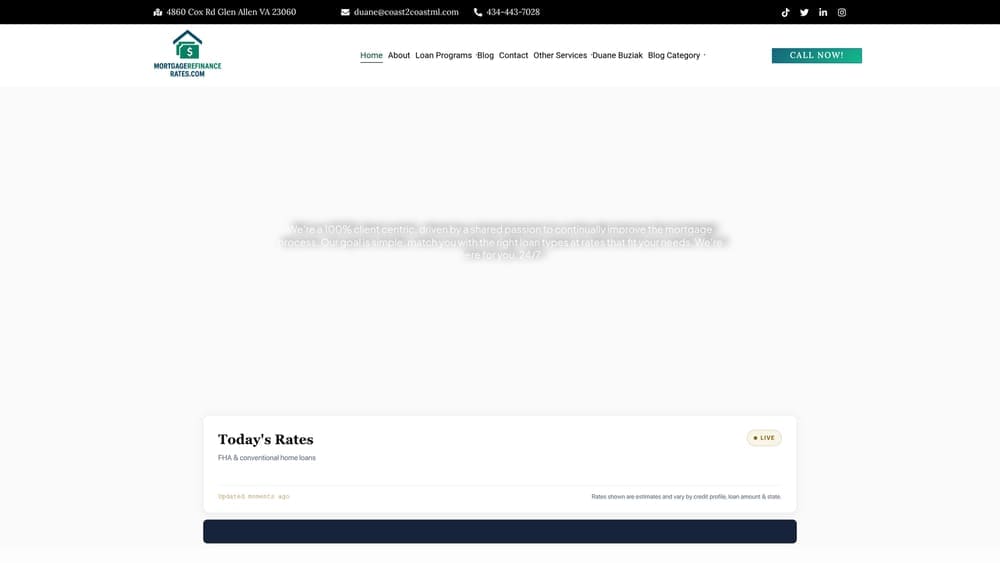
MortgageRefinanceRates.com is a wholesale mortgage broker operation run by Duane Buziak (NMLS #1110647) under Coast2Coast Mortgage LLC (NMLS #376205), giving borrowers access to pricing from 500+ wholesale lenders rather than a single retail shelf — a structural pricing advantage that retail lenders like Rocket Mortgage, Veterans United, and Movement Mortgage cannot replicate by design.
Where This Tool Shines
The most immediate differentiator is the NoTouch Credit Pull process. Most retail lenders require a hard credit inquiry before showing you a rate — and each hard inquiry can shave points off your FICO score. The NoTouch Credit Pull is a soft credit pull mortgage process that lets you see real rate options without a hard inquiry mortgage pre approval requirement. That matters enormously when you’re comparison shopping across multiple programs.
For a senior homeowner with a $350,000 home and a $120,000 remaining mortgage who needs $80,000 cash, a cash-out refinance creates a new $200,000 loan. At an illustrative rate of 7.25% on a 30-year term, the monthly principal and interest payment would be approximately $1,364. The loan balance is fixed and does not grow. The borrower retains full ownership. Compare that to a HECM on the same home: upfront costs alone can exceed $15,000 (origination fee, 2% upfront MIP of $7,000, plus closing costs), and the balance grows monthly. Wholesale broker closing costs on the same cash-out transaction might run $4,000 to $6,000 — a meaningful difference.
Key Features
NoTouch Credit Pull: Soft pull mortgage broker process — see rate options with no credit hit mortgage application required, protecting your FICO during comparison shopping.
500+ Wholesale Lender Access: Structural rate advantage vs. retail lenders who price from a single shelf; particularly valuable for rate-sensitive seniors on fixed income.
Cash-Out LTV Ceiling: Up to 80% LTV on conventional; 100% LTV for eligible VA borrowers — the highest ceiling available in any standard refinance program.
No Hard Inquiry Pre-Approval: Mortgage pre approval without hard pull means you can explore options across multiple programs before committing to a single application.
Licensed States: Virginia, Florida, Tennessee, and Georgia. Call 804-212-8663 for a no-obligation review.
Best For
Seniors in VA, FL, TN, or GA who want to compare rates across multiple programs — conventional cash-out, VA, FHA, or jumbo — without accepting a hard pull from each lender. Also ideal for borrowers who want a broker advocate rather than a retail loan officer who can only sell one company’s products.
Pricing
Wholesale lender credit pricing with no retail markup. Closing costs vary by loan amount and program. Call 804-212-8663 or visit the site for a no-obligation soft pull review.
2. VA Cash-Out Refinance to 100% LTV
Best for: Senior veterans and surviving spouses who want maximum equity access with no private mortgage insurance.
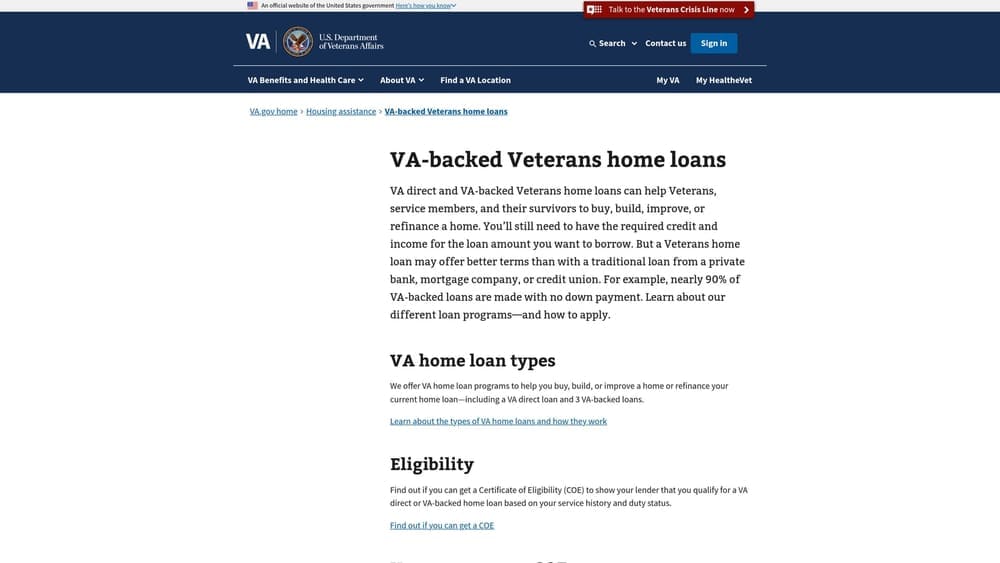
The VA cash-out refinance allows eligible veterans, active-duty service members, and qualifying surviving spouses to access 100% of the home’s appraised value — the highest LTV ceiling of any standard refinance program in the U.S. market. No conventional program comes close to this ceiling for cash-out purposes.
Where This Tool Shines
The 100% LTV ceiling is the headline advantage, and it’s significant. A veteran with a $350,000 home and a $120,000 mortgage could theoretically access up to $230,000 in equity (minus closing costs and the VA funding fee). The loan balance is fixed and does not grow over time — a critical structural difference from a reverse mortgage, where the balance compounds monthly and can eventually exceed the home’s value.
There is no private mortgage insurance on VA loans. The VA funding fee applies instead, but it can be waived entirely for veterans with a service-connected disability rating — making this program effectively free of ongoing insurance costs for many disabled senior veterans. Your heirs inherit full equity minus the remaining loan balance, with no growing debt to contend with.
Key Features
100% LTV Cash-Out: No other conventional program matches this ceiling — VA cash-out is always 100% LTV, never 90%.
No PMI: VA funding fee applies (2.15% to 3.3% of loan amount) but may be waived for veterans with service-connected disability ratings.
Fixed Loan Balance: Unlike a reverse mortgage, the balance does not grow over time — monthly payments reduce principal from day one.
Estate Preserved: Heirs inherit full equity minus the remaining loan balance; no compounding debt to navigate.
Wholesale Access: Available through MortgageRefinanceRates.com in VA, FL, TN, GA — wholesale pricing vs. retail shelf rates from VA-specialist retail lenders.
Best For
Veteran seniors who need maximum cash access, particularly those with service-connected disability ratings that waive the funding fee. Also valuable for surviving spouses who qualify under VA eligibility rules and want to avoid reverse mortgage trade-offs.
Pricing
VA funding fee of 2.15% to 3.3% (waived for veterans with service-connected disability rating). No PMI. Available through MortgageRefinanceRates.com in VA, FL, TN, and GA.
3. FHA Streamline Refinance
Best for: Seniors with an existing FHA mortgage who want the fastest path to a lower monthly payment with minimal documentation.
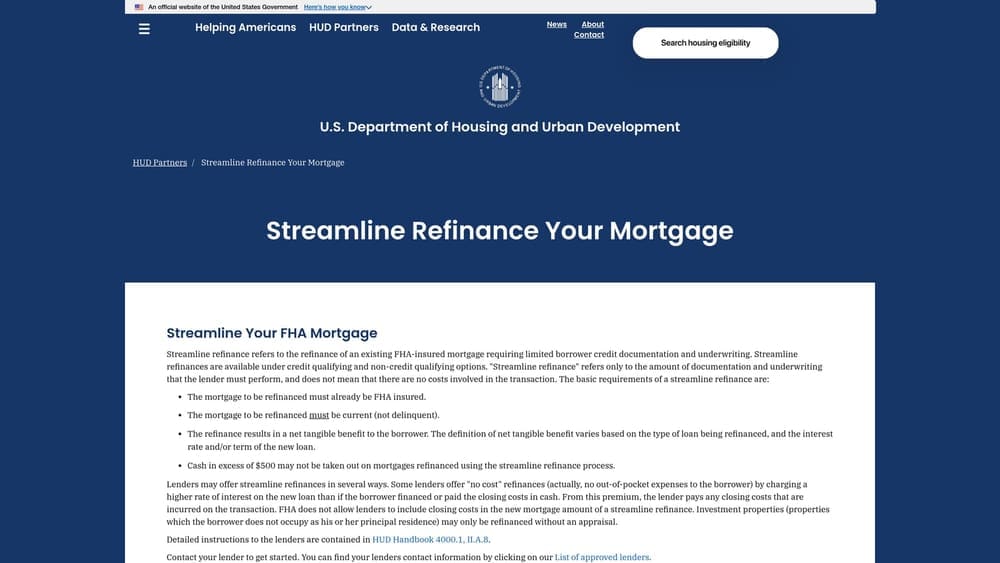
The FHA Streamline Refinance, governed by HUD guidelines, is one of the most borrower-friendly refinance programs available — specifically because it eliminates most of the documentation burden that makes full refinances difficult for seniors on fixed income.
Where This Tool Shines
No appraisal. No income verification in most cases. No asset documentation. If you have an existing FHA loan and can demonstrate a net tangible benefit — typically a lower monthly payment or reduced interest rate — you can often qualify without the full underwriting process that trips up seniors whose income profile looks different in retirement than it did during their working years.
For a senior who originated an FHA loan in 2022 or 2023 at elevated rates, a Streamline refinance into a lower rate can meaningfully reduce monthly obligations without consuming any equity. The break-even math is straightforward: divide closing costs by monthly savings to find your payback period. At $3,000 in closing costs and $150 in monthly savings, you break even in 20 months — after which every month represents net cash flow improvement.
Key Features
No Appraisal Required: Home value is not a barrier to qualifying — particularly valuable in markets where values have shifted since origination.
No Income Verification: Most cases require no income documentation — ideal for seniors on Social Security, pension, or investment income who find full underwriting challenging.
Net Tangible Benefit Requirement: Must demonstrate a lower payment or rate — ensures the refinance actually benefits the borrower.
Existing FHA Loan Required: Cannot be used to switch from conventional to FHA or to pull cash out — this is a rate-and-payment reduction tool only.
Faster Closing: Streamlined underwriting typically means a faster timeline than a full conventional refinance.
Best For
Seniors with existing FHA mortgages originated at elevated rates in 2022 through 2024 who want payment relief without consuming equity or navigating full income documentation requirements. Not suitable for cash-out needs.
Pricing
Upfront MIP of 1.75% (can be financed into the loan balance); annual MIP applies. Available through MortgageRefinanceRates.com in VA, FL, TN, and GA.
4. Rate-and-Term Refinance (Conventional)
Best for: Seniors with conventional loans who want to reduce their monthly payment without touching their equity position.
A conventional rate-and-term refinance is the simplest form of refinancing: you replace your existing loan with a new one at a lower rate, a longer term, or both — without pulling any cash out and without the complexity of a reverse mortgage.
Where This Tool Shines
This option is particularly valuable for seniors who originated their mortgage between 2022 and 2024, when rates reached multi-decade highs. According to Freddie Mac’s Primary Mortgage Market Survey, rates during that period were substantially higher than historical averages — meaning many seniors are carrying above-market rates right now. A rate-and-term refinance captures the rate improvement without consuming any equity.
Extending the loan term to 30 years can also meaningfully reduce the monthly payment obligation even without a rate drop. A senior who owes $180,000 with 15 years remaining at 7.5% carries a monthly P&I of approximately $1,669. Refinancing that balance to a new 30-year term at a lower rate can reduce the payment substantially — freeing monthly cash flow without a reverse mortgage, without growing debt, and without surrendering any ownership stake.
Key Features
No Equity Consumed: 100% ownership stake maintained — this is purely a payment and rate optimization tool.
Term Extension Option: Extending to a 30-year term maximizes monthly payment reduction independent of rate movement.
Simpler Qualification: No cash-out component means some qualification requirements are less stringent than a cash-out refinance.
500+ Lender Access: Wholesale broker pricing across hundreds of lenders delivers competitive rates that single-shelf retail lenders cannot match structurally.
2026 Conforming Limits: The 2026 FHFA baseline conforming loan limit is $806,500 ($1,249,125 in high-cost areas) — most conventional rate-and-term refinances fall within these limits.
Best For
Seniors with conventional loans originated at elevated rates who want to reduce monthly obligations without accessing equity. Also suitable for borrowers who want to simplify their financial picture with a lower payment and have no immediate cash need.
Pricing
Closing costs typically run 2% to 5% of the loan amount; wholesale lender credits can offset a meaningful portion of upfront costs. Available in VA, FL, TN, and GA.
5. Debt Consolidation Refinance
Best for: Seniors carrying high-interest consumer debt who want to free monthly cash flow without a reverse mortgage.
A debt consolidation refinance is a cash-out refinance structured specifically to pay off high-interest consumer obligations — credit cards, medical debt, personal loans — replacing debt at 18% to 29% APR with mortgage-rate debt. The result is a single monthly payment and meaningfully improved monthly cash flow.
Where This Tool Shines
The math here can be compelling. A senior carrying $30,000 in credit card debt at 22% APR faces minimum payments that barely touch principal. Rolling that $30,000 into a mortgage at current rates replaces high-cost revolving debt with fixed, amortizing mortgage debt — and the monthly savings on the eliminated credit card payments can be substantial. The total interest cost over time depends on how long the mortgage runs, which is why paying down the new balance aggressively when possible makes sense.
This is a meaningful reverse mortgage alternative for seniors whose cash flow problem is driven by consumer debt rather than insufficient equity access. You’re not surrendering ownership. You’re not accepting a growing loan balance. You’re restructuring existing obligations at a lower rate using equity you’ve already built.
Key Features
High-APR Debt Replacement: Replaces credit card and medical debt at 18% to 29% APR with fixed mortgage-rate debt — a dramatic rate reduction on the consolidated balances.
Single Monthly Payment: Eliminates multiple debt obligations and replaces them with one fixed payment, simplifying budgeting on a fixed income.
Monthly Cash Flow Relief: The difference between eliminated credit card minimums and the mortgage payment increase can free meaningful cash each month.
Tax Consideration: Mortgage interest may be tax-deductible in some cases — consult a tax advisor for your specific situation.
Equity and Income Requirements: Sufficient home equity and income qualification required; a soft credit pull mortgage review can confirm eligibility before you commit.
Best For
Seniors with sufficient equity who are carrying high-interest consumer debt and want to free monthly cash flow. This strategy works best when the monthly savings on eliminated debt payments meaningfully exceed the increase in mortgage payment.
Pricing
Same structure as a cash-out refinance; the loan amount increases by the amount of debt being consolidated. Available through MortgageRefinanceRates.com in VA, FL, TN, and GA.
6. Jumbo Cash-Out Refinance (High-Value Homes)
Best for: Seniors whose home value exceeds the 2026 FHFA conforming loan limit who want equity access outside conventional program parameters.
A jumbo cash-out refinance addresses a gap that standard programs cannot fill: for seniors with high-value properties, conventional conforming programs simply don’t cover the full loan amount. The 2026 FHFA baseline conforming limit is $806,500, with a high-cost area ceiling of $1,249,125. Anything above those thresholds requires a jumbo program.
Where This Tool Shines
Jumbo pricing varies dramatically by lender — far more than conforming loan pricing. This is precisely where wholesale broker access delivers its greatest advantage. A retail lender like Rocket Mortgage or Movement Mortgage prices jumbo loans from a single shelf. A wholesale broker accesses multiple jumbo investors simultaneously, which can mean a materially different rate on a $1.2 million loan. On a large balance, even a modest rate differential translates to significant monthly savings.
For seniors with high-value properties who are considering a reverse mortgage, the jumbo cash-out alternative preserves estate value in a way that a HECM cannot. The loan balance is fixed. The estate passes to heirs with a known, fixed remaining mortgage — not a compounding balance that may have grown unpredictably over years.
Key Features
2026 Program Thresholds: Designed for loan amounts above the $806,500 FHFA baseline or $1,249,125 in high-cost areas — fills the gap conventional programs cannot reach.
Wholesale Investor Access: Jumbo pricing varies widely across lenders; wholesale broker access to multiple jumbo investors is a structural advantage that retail lenders cannot replicate.
LTV Parameters: Typically 70% to 80% LTV for cash-out on jumbo programs — varies by lender and loan amount.
Documentation Requirements: Reserves and documentation requirements are typically more extensive than conforming programs — plan for a more thorough underwriting process.
Estate Preservation: Fixed loan balance vs. growing reverse mortgage balance — a critical distinction for seniors with high-value properties and estate planning objectives.
Best For
Senior homeowners in higher-cost markets — including parts of Virginia, Florida, and Georgia — whose property values exceed conforming limits and who want equity access without reverse mortgage trade-offs. Also relevant for seniors with significant equity in high-value properties who have estate planning priorities.
Pricing
Jumbo rates and fees vary significantly by lender and loan amount. Wholesale access across multiple jumbo investors is the primary pricing advantage. Available in VA, FL, TN, and GA — call 804-212-8663 for a no-obligation review.
Broker vs. Retail Lender: A Structural Comparison
Understanding the structural difference between a wholesale mortgage broker and a retail lender matters when you’re comparing programs. Here’s how the models differ on the factors that affect senior refinance borrowers most directly.
| Factor | MortgageRefinanceRates.com (Wholesale Broker) | Rocket Mortgage (Retail) | Veterans United (Retail) | Movement Mortgage (Retail) |
|---|---|---|---|---|
| Rate Access | 500+ wholesale lenders | Single retail shelf | Single retail shelf | Single retail shelf |
| Lender Fees | Wholesale pricing, no retail markup | Retail markup applies | Retail markup applies | Retail markup applies |
| Cash-Out LTV (VA) | 100% LTV | Retail VA terms | Retail VA terms | Retail VA terms |
| Program Access | Conventional, VA, FHA, Jumbo, Debt Consol. | Limited to own products | VA-specialist focus | Limited to own products |
| FICO Floor | Varies by investor; soft pull first | Set by retail guidelines | Set by retail guidelines | Set by retail guidelines |
| Credit Pull Process | NoTouch Credit Pull (soft pull first) | Hard pull typically required | Hard pull typically required | Hard pull typically required |
| Licensed States | VA, FL, TN, GA | Nationwide | Nationwide | Nationwide |
Frequently Asked Questions About Reverse Mortgage Alternatives
Q1: What is the current mortgage refinance rate in 2026?
Current national average mortgage rates are published weekly by Freddie Mac’s Primary Mortgage Market Survey at freddiemac.com/pmms — this is the most reliable source for current rate benchmarks, as rates change weekly based on market conditions.
Q2: Can I refinance my mortgage without a hard credit pull?
Yes — MortgageRefinanceRates.com uses the NoTouch Credit Pull process, a soft credit pull mortgage approach that allows you to see real rate options without a hard inquiry mortgage pre approval requirement, protecting your FICO score during comparison shopping.
Q3: How does a mortgage broker get me a lower refinance rate than Rocket Mortgage?
A wholesale mortgage broker accesses pricing from 500+ lenders simultaneously, while Rocket Mortgage prices from a single retail shelf with a markup built in — the structural difference means brokers can often deliver lower rates, though individual results vary by loan profile and market conditions.
Q4: What is the break-even point on a mortgage refinance in 2026?
The break-even point is calculated by dividing total closing costs by monthly payment savings — for example, $5,000 in closing costs divided by $200 in monthly savings equals a 25-month break-even, after which every month represents net savings.
Q5: Can I do a VA cash-out refinance to 100% LTV in 2026?
Yes — VA cash-out refinance allows eligible veterans and qualifying surviving spouses to access 100% of the home’s appraised value; VA cash-out is always 100% LTV, never 90%, making it the highest LTV ceiling of any standard refinance program.
Q6: How does NoTouch Credit Pull work for a mortgage refinance rate quote?
The NoTouch Credit Pull is a mortgage pre approval without hard pull process — your broker pulls a soft inquiry to assess your credit profile and generate rate options across multiple wholesale lenders without triggering the FICO score impact that a hard inquiry causes.
Q7: What is the difference between a rate-and-term refinance and a cash-out refinance?
A rate-and-term refinance changes your interest rate or loan term without accessing equity, while a cash-out refinance increases your loan balance to provide cash proceeds — rate-and-term is simpler to qualify for and preserves your full equity position.
Q8: How do I compare refinance rates across multiple lenders without hurting my credit score?
Use a no credit hit mortgage application process like the NoTouch Credit Pull at MortgageRefinanceRates.com — a soft pull mortgage broker can show you rates across hundreds of wholesale lenders without triggering a hard inquiry on your credit report, allowing genuine comparison shopping before you commit.
Which Option Fits Your Situation
The right reverse mortgage alternative depends on your loan type, military status, home value, and whether you need cash or just payment relief. Here’s a quick framework.
Veteran or surviving spouse: Start with the VA cash-out refinance at 100% LTV. It’s the highest equity access ceiling available, carries no PMI, and the funding fee may be waived entirely if you have a service-connected disability rating. Access through a wholesale broker in VA, FL, TN, or GA for competitive pricing vs. VA-specialist retail lenders.
Existing FHA loan, need payment reduction: The FHA Streamline is your fastest path — no appraisal, no income verification in most cases, and a faster closing timeline than a full conventional refinance.
Conventional loan, no cash need: A rate-and-term refinance preserves your full equity position while reducing your monthly payment. Particularly valuable if you originated your loan between 2022 and 2024 at elevated rates.
High consumer debt load: A debt consolidation refinance replaces 18% to 29% APR credit card and medical debt with fixed mortgage-rate debt, freeing monthly cash flow without a reverse mortgage or growing loan balance.
High-value property above $806,500: A jumbo cash-out refinance addresses equity access on properties outside conforming limits — wholesale broker access to multiple jumbo investors is especially valuable here, where pricing variation across lenders is widest.
If you’re in Virginia, Florida, Tennessee, or Georgia and want to see real rate options across these programs without a hard credit pull, Compare personalized refinance rates now through MortgageRefinanceRates.com. The NoTouch Credit Pull process means your FICO score is protected while you evaluate your options — no obligation, no hard inquiry, no pressure.

