


A low appraisal doesn’t have to kill your refinance. If your home came in under the expected value, you’re not out of options — you may just need to match your situation to the right program.
Several government-backed and conventional refinance paths are specifically designed to work around appraisal shortfalls, waive the appraisal entirely, or use automated valuation models instead of a full physical inspection. The key is knowing which program fits your loan type, your current LTV, and your lender’s eligibility criteria.
This guide covers the best refinance options for borrowers in Virginia, Florida, Tennessee, and Georgia who are dealing with a low appraisal — ranked by how effectively they sidestep or solve the appraisal problem. We’ll show you real math, explain how each program works structurally, and help you identify which path gets you to closing fastest.
Duane Buziak, NMLS #1110647 | Coast2Coast Mortgage LLC, NMLS #376205
1. Coast2Coast Mortgage LLC (MortgageRefinanceRates.com)
Best for: Borrowers who want to shop appraisal waiver eligibility and low-appraisal programs across multiple lenders without a hard credit pull.
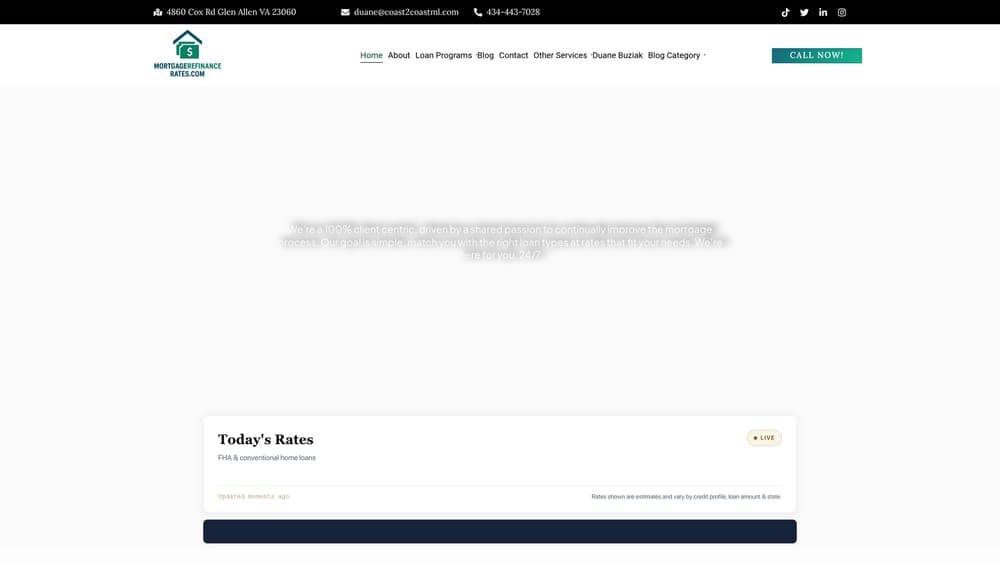
Coast2Coast Mortgage LLC is a wholesale mortgage broker licensed in Virginia, Florida, Tennessee, and Georgia that shops your refinance scenario across 500+ wholesale lenders to find the best appraisal waiver eligibility and low-appraisal program match — using a NoTouch Credit Pull so your credit score stays protected throughout the process.
Where This Tool Shines
The structural advantage of working with a wholesale broker versus a retail lender is access. When you apply through a retail lender like Rocket Mortgage, Veterans United, or Movement Mortgage, you get one rate shelf, one set of underwriting overlays, and one lender’s interpretation of your appraisal situation. Coast2Coast submits your file through Fannie Mae’s Desktop Underwriter and Freddie Mac’s Loan Product Advisor across dozens of wholesale lenders simultaneously, which means your appraisal waiver eligibility gets tested against a much wider grid.
For borrowers dealing with a low appraisal specifically, this matters because PIW and ACE waiver eligibility varies by lender overlay, not just by GSE guidelines. One wholesale lender may approve a waiver where another declines. A broker relationship gives you that breadth without requiring multiple hard inquiries.
Key Features
NoTouch Credit Pull: Coast2Coast uses a soft credit pull mortgage process — meaning you get a full eligibility assessment, program match, and rate comparison with no hard inquiry mortgage pre approval required and no credit hit mortgage application on your record.
Appraisal Waiver Shopping: Access to Fannie Mae PIW and Freddie Mac ACE programs across the wholesale lender network — your file is run through DU and LPA to test waiver eligibility before committing to a full appraisal.
Full Program Access: VA IRRRL, FHA Streamline, HIRO, and FMERR are all available through a single broker relationship — no need to shop each program separately with different lenders.
Wholesale Pricing Structure: As a wholesale broker, Coast2Coast accesses lender pricing that retail borrowers typically cannot reach directly. This is a structural difference in how pricing is built, not a promotional claim.
Mortgage Pre Approval Without Hard Pull: The no hard inquiry mortgage pre approval process means you can explore your options across multiple programs and lenders before any inquiry appears on your credit report.
Best For
Borrowers in VA, FL, TN, or GA who have received a low appraisal and aren’t sure which program applies to their situation. Particularly valuable for borrowers who need to test appraisal waiver eligibility across multiple lenders before deciding whether to fight the appraisal, switch programs, or pursue a streamline path.
Pricing
No upfront broker fee to check eligibility. Lender credit options may be available to offset closing costs at closing depending on the program and rate selected. Call 804-212-8663 for a no-obligation review.
2. VA IRRRL (Interest Rate Reduction Refinance Loan)
Best for: Veterans and active-duty borrowers with existing VA loans who want to refinance without a home appraisal.
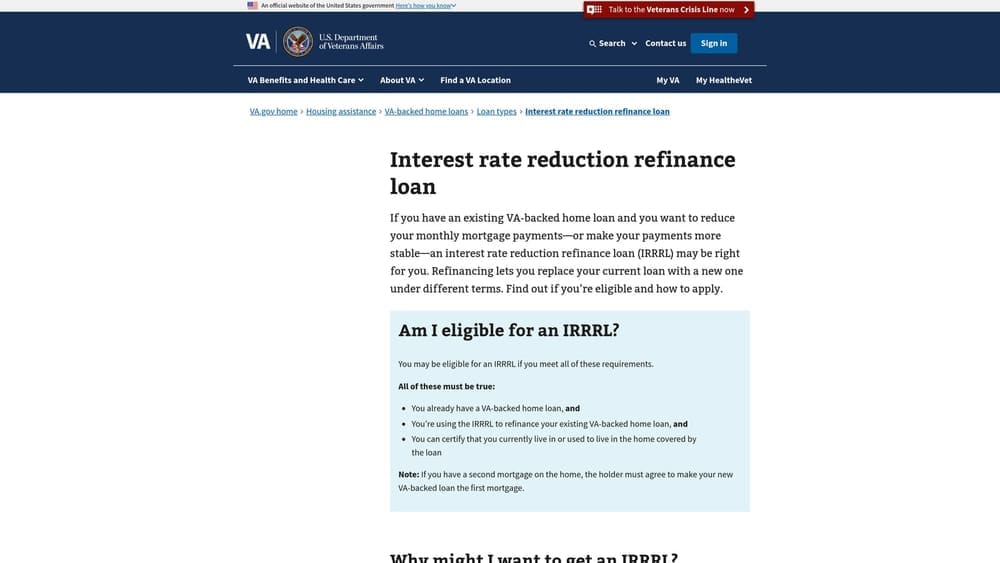
The VA IRRRL is the most direct solution for VA borrowers facing a low home valuation — because in standard IRRRL processing, no appraisal is required at all. The VA simply doesn’t need your current home value to approve the refinance.
Where This Tool Shines
The IRRRL eliminates the appraisal problem entirely for eligible VA borrowers. Because the program is designed to reduce the interest rate or move a borrower from an adjustable-rate to a fixed-rate loan, the VA’s underwriting focus is on payment improvement and loan history — not current collateral value. This makes it uniquely powerful in markets where home values have declined or in situations where a specific appraiser came in well below expectations.
It’s worth noting that the VA cash-out refinance is a separate program and operates differently. VA cash-out refinances are available to 100% LTV — never 90% — and do require a full appraisal since the loan amount is tied to current value. The IRRRL’s no-appraisal benefit applies specifically to the streamline path.
Key Features
No Appraisal Required: Standard IRRRL processing does not require a home appraisal, making it immune to low valuation issues.
No Income Verification: Most IRRRL scenarios do not require income documentation, simplifying the process significantly.
Rate Reduction Requirement: The refinance must result in a lower interest rate or move the borrower from an ARM to a fixed-rate loan.
VA Funding Fee: The IRRRL carries a 0.5% VA funding fee, which may be financed into the loan balance.
Existing VA Loan Required: You must already have a VA-backed loan to use this program — it cannot be used to refinance a conventional or FHA loan into VA.
Best For
Veterans and active-duty service members in Virginia, Florida, Tennessee, or Georgia with existing VA loans who want to lower their rate without triggering a new appraisal. Particularly strong for borrowers in markets with recent value declines or disputed comps.
Pricing
Government program — no program fee. VA funding fee of 0.5% applies to IRRRL transactions and may be financed into the loan. Standard lender origination fees apply.
3. FHA Streamline Refinance
Best for: Existing FHA loan holders in declining markets who want to refinance without a new appraisal.
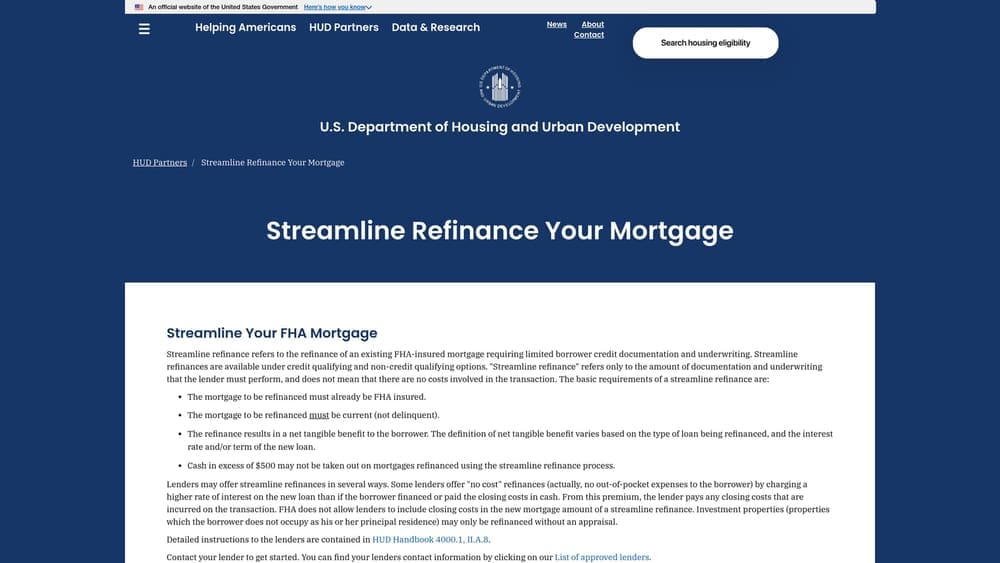
The FHA Streamline Refinance is HUD’s answer to the low appraisal problem for FHA borrowers — the program explicitly excludes the appraisal requirement and uses the original purchase price or original appraised value to calculate LTV instead of the current market value.
Where This Tool Shines
The FHA Streamline’s most powerful feature for borrowers facing a low appraisal is the valuation methodology. Rather than ordering a new appraisal and being subject to today’s market conditions, HUD anchors the LTV calculation to your original loan value. This means a borrower who purchased at $350,000 but whose home is now appraised at $290,000 can still refinance — because HUD isn’t looking at the $290,000 figure.
There’s also a meaningful financial benefit if you’re within three years of your original FHA loan: the Upfront Mortgage Insurance Premium (UFMIP) refund credit can offset a portion of the new UFMIP on the streamline, reducing your out-of-pocket cost at closing.
Key Features
No Appraisal Required: HUD uses the original appraised value or purchase price — current market value is not a factor in the streamline LTV calculation.
No Income Verification: Most FHA Streamline scenarios do not require income documentation or employment verification.
Net Tangible Benefit Required: The refinance must produce a measurable benefit — typically a rate reduction or a move from an adjustable-rate loan.
UFMIP Refund Credit: If refinancing within three years of the original FHA loan closing, a partial UFMIP refund credit applies to reduce the new upfront MIP.
Current Payment History Required: Borrowers must be current on their existing FHA mortgage with no recent late payments.
Best For
FHA borrowers in VA, FL, TN, or GA whose homes have declined in value since purchase, or who received an unexpectedly low appraisal on a standard refinance attempt. Strong fit for borrowers who purchased in 2021-2022 at peak prices and are now equity-thin.
Pricing
Government program — lender fees and FHA MIP apply. Annual MIP continues on FHA loans unless the loan is paid off or refinanced to a conventional product.
4. Fannie Mae High LTV Refinance Option (HIRO)
Best for: Conventional borrowers with Fannie Mae-backed loans who are underwater or near-underwater and need to refinance above standard LTV ceilings.
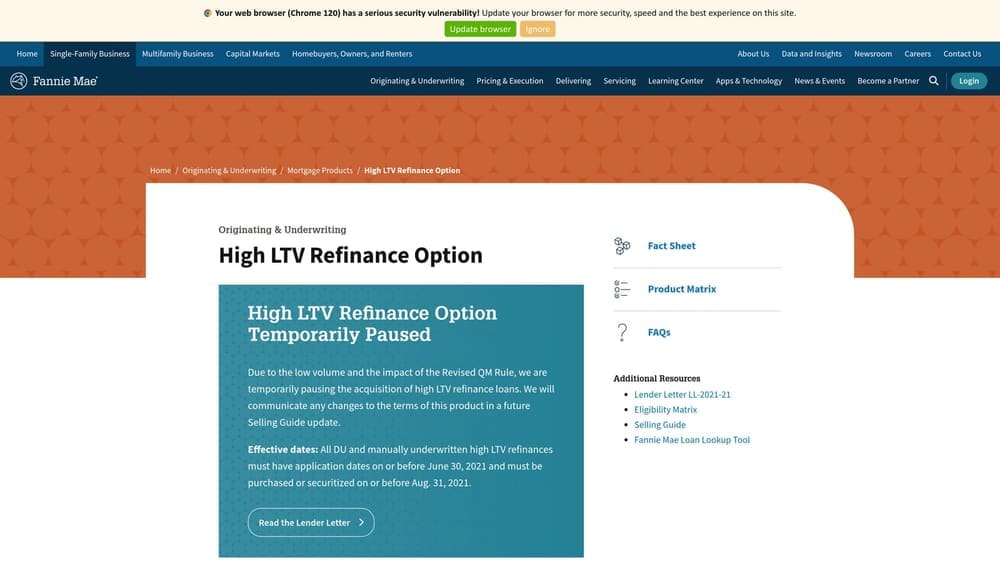
Fannie Mae’s HIRO program was built for exactly the situation a low appraisal creates: a conventional borrower whose LTV exceeds 97.01% and who cannot refinance through standard channels. HIRO has no maximum LTV ceiling, meaning it works even when a borrower is significantly underwater.
Where This Tool Shines
The absence of a maximum LTV cap is what sets HIRO apart from standard conventional refinancing. Most conventional programs cap LTV at 95-97%, which means a low appraisal that pushes your ratio above that threshold kills the deal. HIRO removes that ceiling entirely for qualifying Fannie Mae-backed loans, making it the right tool for borrowers who are genuinely underwater — not just equity-thin.
An additional benefit: appraisals may be waived through Fannie Mae’s Desktop Underwriter (DU) for qualifying HIRO scenarios. If DU issues a PIW, the low appraisal that triggered the problem in the first place becomes irrelevant to the transaction.
Key Features
No Maximum LTV Ceiling: HIRO works regardless of how far underwater the borrower is — there is no LTV cap on qualifying loans.
DU Appraisal Waiver Possible: Desktop Underwriter may issue a Property Inspection Waiver on qualifying HIRO files, eliminating the appraisal requirement entirely.
Clean Payment History Required: No 30-day late payments in the past six months; no 60-day lates in the past 12 months.
15-Month Seasoning: The existing Fannie Mae loan must have been originated at least 15 months before the new loan note date.
Fannie Mae Ownership Required: The existing loan must be owned by Fannie Mae — verify at fanniemae.com/loanlookup before applying.
Best For
Conventional borrowers in VA, FL, TN, or GA with Fannie Mae-backed loans who are underwater after a low appraisal and cannot qualify for a standard conventional refinance. Verify Fannie ownership before pursuing this path.
Pricing
Conventional program — standard lender fees apply. PMI treatment depends on current LTV and lender overlay. No separate program fee from Fannie Mae.
5. Freddie Mac Enhanced Relief Refinance (FMERR)
Best for: Conventional borrowers with Freddie Mac-backed loans above 97.01% LTV who need a parallel path to HIRO.
Freddie Mac’s FMERR program is the parallel structure to HIRO for borrowers whose loans are owned by Freddie Mac rather than Fannie Mae. Like HIRO, it carries no maximum LTV ceiling and offers appraisal waiver eligibility through Freddie’s Loan Product Advisor.
Where This Tool Shines
FMERR’s appraisal waiver mechanism runs through Freddie Mac’s Automated Collateral Evaluation (ACE) system within Loan Product Advisor. If LPA issues an ACE waiver, the borrower avoids a physical appraisal entirely — which means the low appraisal that blocked the original refinance path simply doesn’t factor into the new transaction.
The key distinction between HIRO and FMERR is GSE ownership of the existing loan. A borrower cannot use HIRO if their loan is owned by Freddie Mac, and vice versa. This makes confirming GSE ownership the critical first step — before any program discussion begins.
Key Features
No Maximum LTV: FMERR is designed for underwater conventional loans with no LTV ceiling on qualifying Freddie-backed loans.
ACE Appraisal Waiver: Freddie Mac’s Automated Collateral Evaluation may waive the physical appraisal requirement through LPA for qualifying files.
Payment History Requirements: Borrower must be current; specific payment history requirements apply per Freddie Mac guidelines.
15-Month Seasoning: The existing Freddie-backed loan must meet the 15-month seasoning requirement before FMERR eligibility.
Freddie Mac Ownership Required: Verify Freddie Mac ownership at freddiemac.com/mymortgage before initiating the application.
Best For
Conventional borrowers in Virginia, Florida, Tennessee, or Georgia with Freddie Mac-backed loans who are above 97.01% LTV and need a relief refinance path. The ACE waiver makes this especially useful when the original low appraisal is the primary obstacle.
Pricing
Conventional program — standard lender fees apply. PMI treatment depends on lender overlay and current LTV structure. No separate Freddie Mac program fee.
6. Fannie Mae PIW / Freddie Mac ACE (Appraisal Waivers)
Best for: Conventional refinance borrowers with LTV under 80% and strong credit profiles who want to skip the appraisal entirely on a rate-and-term refinance.
Fannie Mae’s Property Inspection Waiver (PIW) and Freddie Mac’s Automated Collateral Evaluation (ACE) are AVM-based programs that replace a full physical appraisal with a data model assessment — and when they’re issued, the low appraisal problem disappears from the transaction entirely.
Where This Tool Shines
PIW and ACE waivers are issued automatically through the automated underwriting engines — DU for Fannie, LPA for Freddie — when the borrower’s profile and property data meet the GSEs’ eligibility criteria. They cannot be manually requested, which means the broker or lender running your file through AUS is the key variable. A wholesale broker who submits to multiple lenders can test waiver eligibility across different lender overlays, increasing the probability of a waiver being issued.
Beyond eliminating the appraisal problem, these waivers save borrowers $500 to $900 in appraisal cost and typically reduce the loan timeline by one to two weeks. On a rate-and-term refinance where the borrower has solid equity and a clean credit history, a PIW or ACE waiver is often the fastest and cheapest path to closing.
Key Features
No Physical Appraisal: An AVM-based data model replaces the full inspection — no appraiser visit, no scheduling delay, no low-value risk.
Automatic Issuance: Waivers are issued through DU or LPA — not manually requested — based on borrower profile, property data, and loan characteristics.
Typical LTV Threshold: Most commonly available on rate-and-term refinances with LTV at or below 80%, though specific eligibility depends on the full AUS submission.
Cost and Timeline Savings: Eliminates the appraisal fee ($500-$900 range) and removes one to two weeks from the typical refinance timeline.
Credit and Payment History Factors: Strong credit profile and clean payment history improve the probability of a waiver being issued through AUS.
Best For
Conventional refinance borrowers in VA, FL, TN, or GA with meaningful equity and strong credit who want to avoid a physical appraisal on a rate-and-term refinance. A soft pull mortgage broker submission through multiple lenders maximizes waiver eligibility testing.
Pricing
No separate program fee — the waiver is issued automatically through AUS at no additional cost. Standard lender fees and closing costs apply to the underlying refinance transaction.
7. Jumbo Refinance with Desk Review or Hybrid Appraisal
Best for: High-balance borrowers above the 2026 FHFA conforming limit who need an alternative to a full field appraisal on a jumbo refinance.
For loans above the 2026 FHFA baseline conforming limit of $806,500 (or $1,249,125 in high-cost markets), some wholesale lenders accept desk reviews or hybrid appraisals in place of a full field appraisal — reducing cost, timeline, and exposure to a problematic in-person valuation.
Where This Tool Shines
Jumbo refinances sit outside the GSE framework, which means there’s no standardized appraisal waiver program equivalent to PIW or ACE. However, the jumbo lender market is not monolithic. Some wholesale lenders in the jumbo space accept desk reviews — which use existing data, prior appraisals, and comparable sales analysis without a physical inspection — or hybrid appraisals that combine AVM data with a limited inspector visit rather than a full licensed appraiser walkthrough.
This matters most in markets where comparable sales are sparse, disputed, or where a full appraisal is likely to come in low due to market conditions. A wholesale broker with access to multiple jumbo lenders can identify which lenders accept alternative valuation methods before the borrower commits to a full appraisal fee.
Key Features
Applies Above 2026 FHFA Limits: Relevant for loan balances above $806,500 (baseline) or $1,249,125 (high-cost markets) where GSE appraisal waiver programs don’t apply.
Desk Review Option: Uses existing property data, prior appraisals, and comparable sales without a physical inspection — faster and typically less expensive than a full field appraisal.
Hybrid Appraisal Option: Combines AVM data with a limited inspector visit, providing a middle ground between a full appraisal and a pure data model.
Lender-Specific Availability: Not a government program — availability depends entirely on individual wholesale lender overlays, making broker access essential.
Market Condition Dependent: Most useful in stable markets with sufficient comparable sales data; less likely to be accepted in highly volatile or data-sparse markets.
Best For
High-balance borrowers in Virginia, Florida, Tennessee, or Georgia refinancing jumbo loans who want to avoid a full field appraisal. Wholesale broker access is the critical variable — retail lenders typically have narrower jumbo overlays.
Pricing
Lender-specific — desk reviews typically cost less than a full field appraisal. Pricing varies by lender, market, and property type. No government program fee applies.
8. Reconsideration of Value (ROV) Process
Best for: Borrowers who received a low appraisal and believe the appraiser missed relevant comparable sales — best used before switching programs entirely.
The FHFA-mandated Reconsideration of Value process is a formal dispute mechanism that allows refinance borrowers to challenge a low appraisal by submitting comparable sales data the original appraiser may have overlooked — and it costs nothing to file.
Where This Tool Shines
An ROV is the right first move when a low appraisal appears to be a data problem rather than a true market value problem. Appraisers sometimes miss recent sales, use geographically distant comps, or fail to account for specific property improvements. The ROV process gives borrowers a structured, lender-mediated channel to present that evidence without ordering a second appraisal.
Under updated FHFA policy, lenders are required to maintain a formal ROV process — this isn’t an informal request. CFPB guidance reinforces borrower rights in this area. If the ROV succeeds and the appraiser revises the value upward, the original refinance path may be fully rescued without switching programs, changing lenders, or absorbing additional appraisal costs.
Key Features
FHFA-Mandated Process: Lenders are required under updated FHFA policy to maintain a formal ROV process — borrowers have a documented right to request it.
Borrower-Submitted Comps: The borrower provides comparable sales the original appraiser may have overlooked; the lender submits these to the appraiser for reconsideration.
No Additional Appraisal Required: A successful ROV can increase the appraised value without ordering and paying for a second full appraisal.
CFPB Reinforcement: CFPB guidance supports borrower rights to request an ROV and receive a written response through the lender.
Program-Neutral: ROV works within any loan program — conventional, FHA, VA, or jumbo — and doesn’t require switching to a different refinance path to pursue.
Best For
Any refinance borrower in VA, FL, TN, or GA who received a low appraisal and has evidence of stronger comparable sales in the area. Should be attempted before switching programs, as a successful ROV is the lowest-cost resolution to an appraisal shortfall.
Pricing
No cost to file an ROV. The borrower submits comps through the lender at no charge. A second full appraisal is a separate, optional step only if the ROV is denied and the borrower wants to pursue a new valuation.
Worked Dollar Example: When a Low Appraisal Blocks a Conventional Refinance
Here’s how the program selection math works in a real scenario. Assume a borrower in Virginia has a loan balance of $320,000 on a 30-year fixed at 7.25%. Their monthly principal and interest payment is approximately $2,183. They want to refinance to a 6.25% 30-year fixed, which would bring their monthly P&I to approximately $1,971 — a savings of roughly $212 per month.
Closing costs in this scenario are $4,500, offset partially by a lender credit through wholesale pricing. At $212 per month in savings, the break-even point is approximately 21 months — a reasonable timeline for a borrower planning to stay in the home.
The problem: the home appraised at $300,000. That puts the LTV at 106.7% — well above the 97% ceiling for standard conventional refinancing. A retail lender at that point has no path forward. But the program options change the picture entirely. If the loan is Fannie Mae-backed, HIRO applies with no LTV ceiling and potential DU appraisal waiver. If it’s an existing FHA loan, the FHA Streamline uses the original appraised value rather than the current $300,000 figure. If it’s a VA loan, the IRRRL requires no appraisal at all. The $212 monthly savings and 21-month break-even remain the same — the program match is what determines whether the refinance closes.
According to the Freddie Mac Primary Mortgage Market Survey, weekly average 30-year fixed rates are tracked publicly and updated weekly — borrowers can monitor current rate movement to time their refinance decision.
Program Comparison: Low Appraisal Refinance Options at a Glance
| Program | Appraisal Required? | Max LTV | Loan Type | Income Verification | FICO Floor | Best For |
|---|---|---|---|---|---|---|
| VA IRRRL | No | No ceiling | Existing VA only | Usually not required | Lender overlay (typically 580+) | VA borrowers with low appraisal |
| FHA Streamline | No | Uses original value | Existing FHA only | Usually not required | Lender overlay (typically 580+) | FHA borrowers in declining markets |
| Fannie Mae HIRO | Maybe (DU waiver possible) | No ceiling (above 97.01%) | Fannie Mae conventional | Required | 620+ | Underwater conventional (Fannie) |
| Freddie Mac FMERR | Maybe (ACE waiver possible) | No ceiling (above 97.01%) | Freddie Mac conventional | Required | 620+ | Underwater conventional (Freddie) |
| PIW / ACE Waiver | No (waiver issued) | Typically under 80% | Conventional | Required | 620+ | Equity borrowers avoiding appraisal |
| Jumbo Desk/Hybrid | Reduced (desk or hybrid) | Lender-specific | Jumbo (above $806,500) | Required | Lender-specific (typically 700+) | High-balance borrowers |
| ROV Process | Yes (disputes existing) | Depends on program | All loan types | Per underlying program | Per underlying program | Borrowers with missed comps |
| Coast2Coast (Broker) | Depends on program matched | Depends on program matched | All of the above | Depends on program matched | Depends on program matched | Borrowers unsure which path fits |
Frequently Asked Questions: Low Appraisal Refinance Options
What is the best refinance option if my home appraisal came in too low in 2026?
The best option depends on your current loan type: VA borrowers should pursue the IRRRL (no appraisal required), FHA borrowers should use the FHA Streamline (uses original value), and conventional borrowers with Fannie or Freddie-backed loans above 97.01% LTV should look at HIRO or FMERR respectively. A wholesale broker can test all of these paths simultaneously.
Can I refinance my mortgage without a hard credit pull?
Yes — Coast2Coast Mortgage LLC uses a NoTouch Credit Pull process, which is a soft credit pull mortgage approach that allows borrowers to check program eligibility and receive rate comparisons with no hard inquiry mortgage pre approval and no credit hit mortgage application on their record.
How does a mortgage broker get me better low-appraisal refinance options than a retail lender?
A wholesale mortgage broker submits your file through Fannie Mae DU and Freddie Mac LPA across multiple wholesale lenders simultaneously, testing appraisal waiver eligibility against different lender overlays — a retail lender can only test against its own single underwriting shelf, which limits both program access and waiver probability.
What is the break-even point on a refinance when I have a low appraisal?
Break-even is calculated by dividing total closing costs by monthly payment savings — in the example above, $4,500 in costs divided by $212 in monthly savings produces a 21-month break-even, meaning the borrower recovers costs within less than two years regardless of which low-appraisal program is used.
Can I do a VA cash-out refinance to 100% LTV if my appraisal came in low?
VA cash-out refinances are available to 100% LTV — never 90% — but they do require a full appraisal since the loan amount is tied to current appraised value; a low appraisal reduces the available cash-out amount but does not disqualify the transaction if the LTV remains at or below 100%.
How does the NoTouch Credit Pull work for a mortgage refinance rate quote?
The NoTouch Credit Pull uses a soft pull mortgage broker process where Coast2Coast pulls a soft inquiry — which does not affect your credit score — to assess your profile, identify eligible programs, and generate rate comparisons across the wholesale lender network before any hard inquiry is authorized.
What is the difference between HIRO and the FHA Streamline for a low appraisal situation?
HIRO applies to conventional loans owned by Fannie Mae with LTV above 97.01% and may offer a DU appraisal waiver; the FHA Streamline applies only to existing FHA loans and uses the original appraised value rather than current market value, making it effective even in markets with significant value declines since purchase.
How do I compare low-appraisal refinance options across multiple lenders without hurting my credit score?
Use a mortgage pre approval without hard pull process — a soft pull mortgage broker like Coast2Coast can run your scenario through multiple wholesale lenders and automated underwriting systems using a no credit hit mortgage application approach, so your score is protected while you evaluate all available program paths.
Choosing the Right Path Forward
A low appraisal narrows your options on a standard conventional refinance — but it doesn’t eliminate your options entirely. The right program depends on one primary question: what type of loan do you currently have?
If you have a VA loan, the IRRRL is your fastest path — no appraisal, no income verification, and a straightforward rate reduction process. If you have an FHA loan, the FHA Streamline sidesteps the current market value entirely. If you have a conventional loan backed by Fannie Mae or Freddie Mac and you’re above 97% LTV, HIRO or FMERR are the programs built specifically for your situation. And if your LTV is under 80% with strong credit, a PIW or ACE waiver may eliminate the appraisal question before it ever becomes a problem.
Before switching programs, always consider filing an ROV first. It costs nothing and may resolve the appraisal issue without changing your loan structure at all.
The most important structural advantage in a low-appraisal scenario is working with a wholesale broker who can test your eligibility across multiple programs and lenders simultaneously — using a soft credit pull mortgage process that protects your score throughout. Compare personalized refinance rates now with no obligation and no hard inquiry. Coast2Coast Mortgage LLC serves borrowers in Virginia, Florida, Tennessee, and Georgia. Call 804-212-8663 to speak with a licensed loan officer about your specific situation.

